
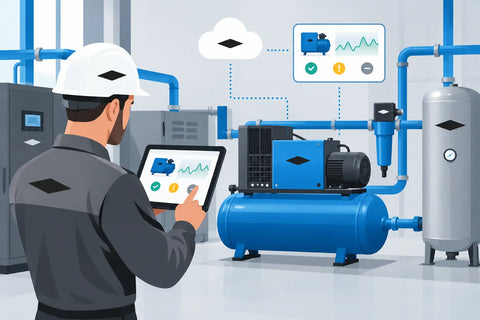
A compressor rarely fails at a convenient time. It fails in the middle of a production run, during a high-demand shift, or when a facility has no backup capacity. Predictive maintenance gives maintenance teams a way to spot the warning signs before a small mechanical, electrical, or air-quality issue becomes a shutdown.
For compressed air and vacuum systems, the goal is not to replace every preventative maintenance task. Oil changes, filter replacements, inspections, and manufacturer-required service intervals still matter. The value of predictive maintenance is that it adds condition-based evidence to those routine tasks, helping teams service equipment when operating data shows a real need and prioritize risks before they affect uptime.
What Predictive Maintenance Actually Means
Predictive maintenance uses measurable equipment conditions to estimate when a component is likely to need attention. Instead of waiting for a failure or servicing equipment only by calendar hours, a maintenance team monitors changes in performance and investigates abnormal trends.
On an air compressor, those trends may include rising discharge temperature, higher pressure drop across filters, increased vibration, longer loaded run time, declining flow, or abnormal oil condition. On a vacuum pump, they may show up as reduced vacuum level, temperature changes, seal problems, vibration, or power draw that no longer matches normal operating conditions.
The difference between preventative and predictive work is practical. Preventative maintenance follows a schedule. Predictive maintenance asks whether the equipment is behaving as expected between scheduled services. The strongest reliability programs use both approaches.
Why It Matters to Plant Operations
Compressed air and vacuum are utility systems, but their failure can stop far more than the equipment room. A pressure loss can idle automation, packaging lines, tools, controls, and process equipment. Poor air quality can create reject product, damage pneumatic components, or introduce problems in sensitive healthcare, food, beverage, and electronics environments. Vacuum instability can disrupt holding, conveying, forming, drying, and laboratory processes.
Unplanned failures also carry costs that do not appear on a replacement-parts invoice. There may be overtime, expedited freight, rental equipment, lost production, emergency labor, and delayed customer commitments. In some facilities, the largest cost is simply the time required to return a system to stable operating conditions after a shutdown.
Condition monitoring helps operations leaders make better decisions earlier. A bearing trend, a growing pressure differential, or a compressor that is running hotter than its baseline gives the team time to schedule service around production rather than reacting to an outage.
What to Monitor on Compressed Air Equipment
Not every facility needs a full network of sensors on every asset. The right level of monitoring depends on system criticality, redundancy, equipment age, operating hours, and the cost of downtime. Start with the equipment whose failure would create the biggest operational problem.
Pressure, flow, and demand patterns
System pressure is a useful starting point, but it should not be viewed alone. A pressure drop may be caused by a failing compressor, undersized piping, clogged filters, a dryer restriction, a major leak, or a sudden increase in demand. Monitoring flow and compressor run status alongside pressure provides a clearer picture.
Pay attention to changes in load and unload cycles. A compressor that once maintained demand efficiently but now spends more time loaded may be responding to leaks, higher production demand, control problems, or reduced output. Trend data makes those changes visible before they become severe.
Temperature and vibration
High operating temperatures shorten the life of lubricants, hoses, seals, motors, and internal compressor components. A gradual temperature increase can indicate poor ventilation, dirty coolers, restricted airflow, low lubricant levels, or developing mechanical issues.
Vibration monitoring is especially valuable for rotating equipment. An increase from the equipment's normal baseline can point to bearing wear, alignment issues, imbalance, loose components, or coupling problems. Vibration data is most useful when paired with a qualified technician who understands the equipment and can distinguish a meaningful change from normal variation.
Air quality and pressure differential
Dryers and filters protect downstream equipment, but they are often overlooked until there is water, oil carryover, contamination, or a noticeable pressure problem. Differential pressure across filters indicates restriction. A rising differential means the compressor is working harder to push air through the system and may be wasting energy.
For refrigerated and desiccant dryers, monitor operating temperatures, dew point where applicable, drain performance, and service indicators. A failed drain can allow moisture to move downstream even when the compressor itself appears to be running normally.
Oil, electrical, and control data
Lubricant condition can reveal contamination, overheating, and wear. Oil analysis is not necessary for every small system, but it can be a smart investment for larger or highly critical compressors. Electrical data is also valuable. Changes in amperage, power consumption, motor temperature, or variable speed drive alarms can identify problems that may not be obvious during a walk-through.
Modern compressor controllers can provide useful alarms and operating history. Those controls are helpful, but an alarm alone is not a maintenance strategy. Someone still needs to review trends, investigate recurring events, and act on the information.
Where Predictive Maintenance Delivers the Best Return
Predictive tools deliver the strongest return where failure consequences are high and warning signs can be measured. A 24-hour manufacturing operation with one primary compressor and limited backup capacity is an obvious candidate. So is a hospital, municipality, brewery, defense operation, or facility where air quality and system availability are closely tied to safety or production requirements.
It may be less economical to install advanced monitoring on a small, lightly used standby unit with easy access to replacement equipment. That does not mean the unit should be ignored. It means a solid preventative maintenance plan, regular inspections, and basic operating checks may be the more appropriate level of coverage.
The key is to match the maintenance approach to risk. Critical equipment deserves deeper visibility. Noncritical equipment still needs disciplined service, but not every asset needs the same investment.
How to Start a Predictive Maintenance Program
Begin by documenting the system as it operates now. Identify compressors, dryers, filters, vacuum pumps, drains, receivers, controls, and major distribution points. Record operating pressures, temperatures, hours, service history, recurring alarms, and known performance concerns. This creates a baseline for comparison.
Next, identify the assets that create the greatest downtime exposure. Consider whether each system has redundancy, how quickly parts can be obtained, whether rental equipment can support the load, and what happens to production if the asset is unavailable. This step keeps monitoring investments focused on the equipment that matters most.
Then establish a practical review process. Data that no one reviews does not prevent failures. Assign responsibility for checking alarms, trend reports, and service findings. Define when a reading requires observation, when it requires a planned repair, and when it requires immediate action. Certified technicians can help validate the baseline, interpret abnormal readings, and perform repairs before the condition progresses.
For many facilities, a maintenance agreement is the most reliable way to keep that process moving. Scheduled visits provide routine service, while operating data and technician findings add the condition-based layer that turns maintenance from a calendar task into an uptime strategy.
Avoid These Common Mistakes
The first mistake is collecting more data than the team can use. Start with a short list of high-value measurements and expand only when the data supports better decisions. The second is treating every alarm as an emergency. Some alarms require immediate response, while others call for verification, trend review, or a planned service visit.
Another common problem is focusing only on the compressor. The air treatment equipment, drains, piping, controls, and downstream demand all affect system performance. A clean, properly maintained compressor cannot compensate for a restricted filter bank, leaking distribution system, failed dryer, or undersized piping.
Finally, do not wait for an obvious problem to establish a baseline. The best time to capture normal pressure, temperature, vibration, and operating patterns is when the system is running well.
Predictive maintenance works best when it supports fast, informed action. If your compressed air or vacuum system is showing changing temperatures, pressure instability, repeated alarms, or unexplained run time, schedule an assessment before the next issue decides your production schedule for you.
