
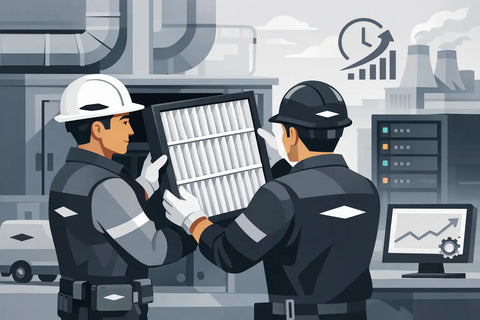
A delayed air filter replacement rarely announces itself with an immediate shutdown. More often, it shows up as creeping pressure drop, higher compressor run time, poor product quality, moisture-related failures, or a downstream device that no longer performs as expected. For plants that rely on compressed air for production, controls, packaging, conveying, instrumentation, or breathing air applications, a filter is not a minor maintenance item. It is a barrier between the air system and costly contamination.
The right replacement schedule protects air quality and operating cost at the same time. The wrong one can create a false economy: a filter element stays in service to avoid a small parts expense, while the compressor consumes more energy to push air through a restricted path. A disciplined filter program gives maintenance teams a practical way to reduce both risks.
Why Air Filter Replacement Is a System Decision
Compressed air filters remove different contaminants at different points in the system. Particulate filters capture pipe scale, dust, and solid debris. Coalescing filters remove aerosols such as oil and water droplets. Activated carbon filters address oil vapor and odor where air-quality specifications demand it. Each element has a finite capacity, and each adds some resistance to airflow.
As an element loads, differential pressure increases. The compressor must work harder to maintain the pressure available at the point of use. Even a modest pressure loss matters in a system with high annual operating hours, especially when operators compensate by turning up the compressor discharge pressure. That raises energy use across the system rather than correcting the restriction at its source.
Contamination risk is just as serious. A saturated or damaged element can allow particles, liquid, aerosols, or vapor downstream. The result depends on the application. It may be a ruined paint finish, a contaminated food or beverage process, sticky pneumatic valves, inaccurate instruments, failed desiccant, or premature wear in vacuum and air-powered equipment. The filter element is inexpensive compared with the process it protects.
Do Not Change Filters Only by Calendar Date
Time-based intervals are useful, but they should not be the only trigger for replacement. Actual filter life depends on compressor operating hours, air demand, ambient conditions, inlet air quality, lubricant carryover, condensate management, and the type of filter installed. A clean indoor facility with properly maintained equipment may have a different replacement need than a dusty manufacturing operation running multiple shifts.
The most reliable approach combines manufacturer recommendations with operating data. Differential pressure indicators or gauges give maintenance teams direct evidence that a filter is becoming restrictive. If the indicator reaches the element manufacturer's recommended change point, replace the element even if the planned date has not arrived.
At the same time, do not wait indefinitely for a gauge reading. Filter media can degrade chemically, seals can harden, and certain contaminants can reduce performance before pressure drop becomes obvious. Coalescing and activated carbon elements are particularly dependent on scheduled service because air quality matters as much as flow restriction.
A maintenance record should capture the installation date, running hours, differential pressure at installation and inspection, element part number, filter location, and any unusual contamination observed. This creates a useful baseline. If one filter begins loading far faster than comparable units, the team can investigate the upstream cause instead of simply replacing elements more often.
Signs the Filter Needs Attention Now
A differential pressure alarm is a clear service signal, but it is not the only one. Inspect the filter promptly when operators report low pressure at a specific production area, rising compressor discharge pressure, excessive condensate, oil odor, inconsistent product quality, or repeated pneumatic component failures.
External signs also matter. Damaged bowls, corroded housings, leaking drains, loose clamps, and compromised seals can defeat a filter even when the element itself is relatively new. On equipment with clear bowls, discoloration or an abnormal liquid level should trigger an inspection. Follow site safety procedures and never open a pressurized filter housing.
Match the Element to the Required Air Quality
An air filter replacement is only effective when the element matches the housing and the application. Similar-looking elements can have very different filtration ratings, media construction, flow capacity, and seal designs. Installing a lower-grade element in a critical process may allow contamination through. Installing an overly fine element where it is not needed can add unnecessary pressure drop and replacement cost.
Start with the required air quality at the point of use. The target should be based on the process, not on a general assumption that every line needs the same level of treatment. General plant air, instrument air, packaging equipment, paint applications, laboratory equipment, food and beverage production, and medical or breathing air services can require very different filtration arrangements.
The order of components matters as well. A typical treatment train may use a water separator before a coalescing filter, followed by a dryer and a final particulate filter. Where oil vapor control is required, an activated carbon stage may be added after effective coalescing filtration. If upstream liquid water or oil overloads the final stage, the expensive element will fail early and air quality will suffer.
This is why recurring element failures should be treated as a system problem. Check compressor lubricant condition and carryover, separator performance, aftercooler operation, automatic drains, dryer performance, piping contamination, and actual flow demand. Replacing a filter without correcting an upstream issue only resets the clock.
A Safe, Repeatable Replacement Process
Before servicing a filter, identify the correct replacement element and verify its compatibility with the housing. Confirm the system's isolation points, lockout requirements, and depressurization procedure. For critical production lines, coordinate the work so that isolation does not create an unplanned outage.
Once the housing is isolated and completely depressurized, open it according to the manufacturer's instructions. Remove the used element carefully and inspect the housing interior. Heavy oil, rust, water, or unusual debris should be documented because it can reveal a problem elsewhere in the air system. Clean the housing only with materials approved for the filter design and application.
Install the new element with the correct seals, seated fully and without forcing it into place. Inspect O-rings for damage and replace them when specified. Reassemble the housing, restore pressure gradually, and check for leaks. Reset the differential pressure indicator or maintenance monitor, then record the service event.
For filters with automatic drains, verify that the drain operates after the system returns to service. A failed drain can flood downstream equipment and sharply reduce the life of coalescing elements. If the filter is protecting a quality-sensitive process, confirm the downstream air-quality requirement after service rather than assuming the new element alone resolves every issue.
Include Filters in Preventive Maintenance Planning
The strongest filter program is built into the site's preventive maintenance plan, not handled as an emergency parts order. Keep critical elements, seal kits, and drain service parts available for equipment that cannot wait for delivery. Standardizing filter housings and approved replacement elements across the facility can simplify inventory, provided each application still receives the correct filtration grade.
Maintenance teams should also review pressure data from the entire compressed air system. A filter may be one source of pressure loss, but undersized piping, leaking couplings, clogged dryer components, improperly sized regulators, and excessive point-of-use demand can produce similar symptoms. Looking at the full system prevents unnecessary repairs and helps prioritize work with the fastest operational payoff.
For multi-shift operations, hospitals, municipalities, and production facilities with little tolerance for interruption, scheduled service support can be especially valuable. Certified technicians can inspect treatment equipment, confirm element selection, identify upstream contamination, and coordinate repairs before a minor restriction becomes a production event. Advanced Air & Vacuum supports this work with multi-brand service capabilities and maintenance planning for compressed air and vacuum systems.
Treat every filter change as a chance to verify the health of the system around it. When replacement intervals are based on real operating conditions, correct elements, and documented inspections, your team protects air quality without paying for unnecessary pressure drop, wasted energy, or avoidable downtime.
