
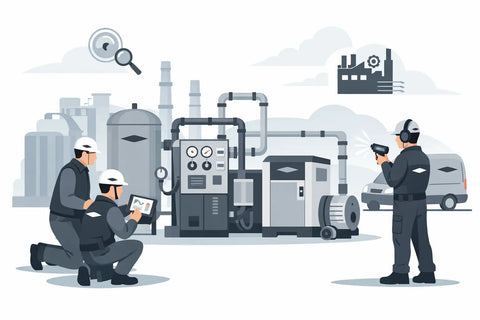
A compressed air system can appear to be working while quietly draining budget, production capacity, and maintenance time. This industrial compressed air audit guide gives plant and facilities teams a practical method for identifying waste before it becomes a breakdown, an air-quality issue, or an expensive equipment replacement.
An effective audit is not limited to walking the plant with an ultrasonic leak detector. It reviews how air is generated, treated, stored, distributed, and consumed. The goal is to match system output to actual demand while protecting the pressure, air quality, and uptime your operation requires.
Start With a Clear Audit Scope
Before collecting readings, define what the audit needs to answer. A food or beverage facility may be focused on moisture and contamination risk. A manufacturer with multiple shifts may be trying to reduce off-shift energy use. A maintenance supervisor dealing with repeated low-pressure calls may need to determine whether the problem is compressor capacity, undersized piping, leaking equipment, or poor controls.
Include all major system components in the scope: compressors, receivers, dryers, filters, drains, controls, piping, point-of-use regulators, and production equipment. If vacuum equipment supports the same process, evaluate it separately rather than assuming its maintenance needs mirror those of the compressed air system.
Gather at least 30 days of utility data, maintenance records, compressor run-hour data, pressure settings, and known production schedules. A single day of readings can be misleading, especially when production volume, ambient temperatures, and operating shifts vary.
Document the Air Supply Side
Start at the compressor room. Record the manufacturer, model, horsepower, rated capacity, pressure rating, control type, service history, and current operating hours for every compressor. Identify which unit is designated as base load, trim, standby, or emergency capacity.
Pay close attention to how compressors are controlled. A system with several machines operating independently can have enough installed capacity yet still waste power through excessive unloading, short cycling, or competing pressure bands. Fixed-speed compressors may be appropriate for steady base demand, while a variable speed compressor often performs best when demand changes significantly. The correct mix depends on the load profile, not simply on the age or size of the machines.
Measure pressure at the compressor discharge and compare it with pressure at critical points of use. Every unnecessary PSI at the supply side increases energy consumption, but lowering the setpoint without correcting restrictions can create production problems. The objective is stable pressure where the process needs it, not the highest possible pressure in the compressor room.
Also inspect ventilation. Compressor rooms that run hot force equipment to work harder and can reduce output. Check intake locations, exhaust paths, fan operation, filter condition, and whether heated discharge air is being recirculated into the room. In Southern California and Arizona, high ambient temperatures can make ventilation and dryer performance especially important during warmer months.
Check Air Treatment, Drainage, and Storage
Compressed air quality failures are often traced to equipment that was installed correctly but not maintained consistently. Review the dryer type and dew point requirement against the application. A refrigerated dryer may be sufficient for general manufacturing air, while instrumentation, electronics, or very dry environments may require a desiccant dryer.
Inspect prefilters and afterfilters, noting differential pressure, element age, and service intervals. A loaded filter restricts flow and creates a pressure drop that operators may compensate for by raising compressor discharge pressure. That response increases energy use across the entire system while masking a relatively simple maintenance issue.
Verify that condensate drains open when needed and close fully afterward. Failed open drains waste compressed air. Failed closed drains send water downstream, where it can damage pneumatic components, affect product quality, and overload filters. Confirm that oil-water separators are sized and maintained for the actual condensate load.
Receiver capacity deserves the same attention. Wet storage near the compressor can stabilize demand and improve moisture removal, while dry storage closer to intermittent high-demand equipment can reduce pressure swings. Storage helps when it is properly located and sized. It cannot correct chronic leaks, inadequate compressor capacity, or poorly managed demand.
Audit the Distribution System
Walk the piping system from the compressor room to the farthest and most sensitive points of use. Look for undersized headers, dead-end runs, excessive flexible hose, corroded pipe, poorly selected fittings, and branches added over time without a distribution plan. These issues create pressure drop and can make a capable compressor system look undersized.
Measure pressure at several locations while the plant is under normal load. The difference between supply pressure and point-of-use pressure helps identify where restrictions are occurring. Take readings during peak demand as well as lower-demand periods. A pressure drop that seems acceptable during a quiet shift may become production limiting when multiple tools, machines, or blow-off stations operate at once.
Document isolation valves and confirm that unused areas can be shut off. Plants frequently continue supplying air to equipment, production lines, or warehouse drops that are no longer needed. Section isolation allows teams to reduce off-shift waste and makes future troubleshooting faster.
Find and Prioritize Leaks
Leaks are one of the most visible audit findings, but they should be documented in a way that supports repair decisions. Use an ultrasonic detector during operating hours, and inspect common failure points such as couplings, quick connects, regulators, hoses, fittings, solenoid valves, and drain valves.
For each leak, record its location, estimated severity, the affected equipment, and the repair required. Mark the leak physically if repairs will not happen immediately. A maintenance list without clear locations often turns into a list of repeat discoveries.
Prioritize leaks by safety, production impact, accessibility, and estimated cost. A large leak in a difficult-to-reach area may need scheduled downtime, while several smaller leaks at accessible connections can often be corrected quickly. Do not overlook off-shift leakage. A system that runs heavily when production is idle is providing a direct measure of avoidable demand.
Evaluate Demand at the Point of Use
Not every air-consuming application is efficient simply because it is operating as designed. Audit the largest users first, including blow-off nozzles, air knives, vacuum generators, pneumatic conveying, baghouses, and intermittently cycling equipment.
Open blowing is a frequent opportunity. In some applications, engineered nozzles, lower pressure, timed controls, or electric alternatives can reduce air use without compromising the process. The trade-off is that any change must be validated with production and quality teams. Air savings that introduce rejects, safety issues, or longer cycle times are not savings.
Review local pressure regulators as well. If a machine needs 80 PSI, it should not be supplied at 110 PSI and throttled down inconsistently through poorly maintained regulators. Standardizing point-of-use pressure requirements helps prevent operators from raising settings to compensate for unrelated distribution or maintenance problems.
Turn Findings Into an Action Plan
A useful audit ends with assigned actions, expected impact, and a verification method. Separate work into immediate corrections, planned maintenance, capital improvements, and operating changes. This keeps a failed drain valve from being delayed by a larger piping project and prevents a major system recommendation from being lost in a list of minor repairs.
Immediate work may include repairing leaks, replacing clogged filters, correcting drain failures, and closing isolation valves. Planned maintenance can address compressor service, dryer rebuilding, hose replacement, and regulator inspections. Capital projects may involve adding storage, replacing restrictive piping, installing controls, or resizing equipment after measured demand has been confirmed.
Track results after each change. Compare compressor run time, kW demand where available, pressure stability, leak load, and production feedback. If pressure problems persist after leak repairs and filter service, collect more detailed demand data before purchasing another compressor. More capacity is sometimes the right answer, but it should be supported by measured demand rather than a reaction to symptoms.
An audit should become part of the maintenance program, not a one-time event. Facilities that schedule periodic reviews catch leaks, pressure loss, and treatment issues while they are manageable. For operations that need certified technicians, multi-brand support, and practical recommendations tied to uptime, Advanced Air & Vacuum can help turn audit findings into a workable service and improvement plan. Goodbye downtime and waste starts with knowing exactly where your compressed air system is losing performance.
