
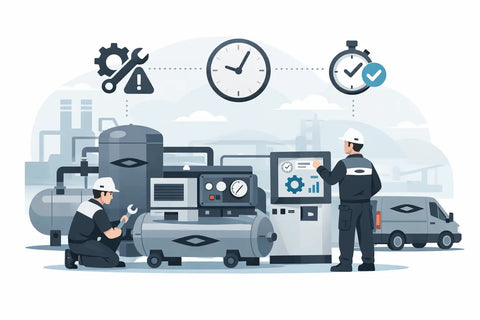
A compressed air failure rarely starts with a dramatic shutdown. More often, it starts with a hot-running compressor, a saturated dryer, a pressure drop no one investigated, or a maintenance interval that slipped past the calendar. If you want to know how to reduce compressed air downtime, the answer is not one fix. It is a system-level approach that removes the most common failure points before they stop production.
For plants, hospitals, municipalities, and process operations, downtime is not just an inconvenience. It can halt packaging lines, disrupt tools and automation, compromise product quality, and push maintenance teams into expensive emergency mode. The operations that keep uptime under control usually do the same few things well: they maintain equipment on schedule, monitor system health, size equipment correctly, and work with service partners who can respond fast when conditions change.
How to reduce compressed air downtime starts with the whole system
One of the biggest mistakes facilities make is treating the compressor as the entire compressed air system. In reality, uptime depends on the performance of the full package - compressor, dryer, filters, drains, controls, piping, storage, and point-of-use conditions. A perfectly good compressor can still go down early if it is forced to work against clogged filters, poor ventilation, unstable demand, or neglected condensate management.
That is why root cause matters more than symptom chasing. Replacing parts after each failure may get you through the week, but it does not solve why the failure happened. If the room runs too hot, the oil breaks down faster. If pressure settings are wrong, the unit short cycles. If the dryer is undersized, moisture carries downstream and causes instrument and valve issues that look unrelated at first.
Reducing downtime starts with evaluating how the system operates under real load, not just how it looked on the day it was installed.
Preventive maintenance beats emergency repair every time
The most reliable way to cut downtime is still the least glamorous one: preventive maintenance done on time. Compressors and related equipment have predictable wear items. Oil, air filters, separators, belts, drains, and dryer components do not fail randomly forever. They degrade in ways that can usually be tracked and addressed before they become production problems.
A disciplined maintenance plan does three things. First, it keeps routine wear from turning into catastrophic failure. Second, it helps maintain design efficiency, which reduces heat and stress on the equipment. Third, it gives technicians regular touchpoints to catch developing issues like vibration, contamination, electrical problems, and control faults.
The trade-off is straightforward. Preventive maintenance requires planning, budget, and scheduled service windows. But those costs are typically minor compared to lost production, rush parts, rental equipment, and after-hours service calls. Facilities that delay maintenance to save money often end up paying more for both repairs and energy.
For operations with multiple shifts or critical processes, automated maintenance scheduling can make a measurable difference. It reduces the chance that a service interval is missed because the team is focused on more visible production priorities.
Maintenance should match operating conditions
Not every system needs the same service cadence. A lightly loaded backup compressor in a clean environment may not require the same attention as a heavily used unit in a hot, dusty production area. Service intervals should reflect run hours, ambient conditions, contamination risk, and duty cycle.
That is one reason generic maintenance habits fall short. A calendar-based approach alone can miss overworked equipment. On the other hand, replacing components too early adds cost without much value. The right plan balances manufacturer guidelines with actual operating conditions.
Monitoring is how you catch trouble before downtime happens
If a system only gets attention when pressure drops or the machine alarms out, the facility is already behind. Monitoring gives maintenance and operations teams early warning. Run hours, discharge temperature, dew point, pressure differential, motor performance, and drain operation can all point to trouble before the compressor goes offline.
This does not mean every facility needs a complex plantwide analytics platform. In some cases, better downtime prevention starts with basic visibility: accurate pressure gauges, service logs, alarm history, and regular inspections. In larger or higher-risk operations, connected monitoring and trending can justify themselves quickly by preventing one serious failure.
The key is acting on the data. A rising temperature trend matters only if someone investigates cooling airflow, lubricant condition, or fouled heat exchangers before the trip event occurs.
Leaks, pressure drop, and poor piping design create hidden downtime risk
Most facilities think of leaks as an energy problem, which they are. But they also contribute to downtime. When leakage forces compressors to run harder and longer, wear accelerates. Systems that should have reserve capacity lose it. Then a minor issue that would have been manageable becomes an urgent outage because there is no cushion left in the system.
Pressure drop creates similar risk. Restrictive filters, undersized piping, bad routing, and neglected treatment equipment can cause low pressure at the point of use even when the compressor itself is operating. That often leads teams to raise system pressure as a workaround. The result is more power consumption, more stress on the equipment, and no real correction of the underlying issue.
A well-designed piping and storage strategy helps stabilize demand, reduce compressor cycling, and preserve usable pressure where it is needed. It is not always the first place people look, but it often has a direct effect on reliability.
Dryers and filters deserve more attention than they get
Compressed air downtime is often blamed on the compressor because that is the most visible asset. In practice, many system problems start in air treatment. If the dryer is not maintaining target dew point, moisture can damage tools, controls, process equipment, and product quality. If filters are overloaded, pressure drop rises and contamination moves downstream.
This is especially important in facilities where air quality is tied to compliance, instrumentation, or sensitive end use. A neglected dryer may not stop production immediately, but it can create a chain of failures that does.
Treatment equipment should be inspected with the same discipline as the compressor. That includes verifying drain function, checking differential pressure across filters, confirming dryer performance, and replacing elements on schedule. It is a simple step that prevents a lot of avoidable calls.
Redundancy matters, but only when it is planned correctly
For operations where compressed air is mission critical, backup capacity is one of the clearest ways to reduce downtime exposure. But redundancy is not just a matter of adding another compressor. The backup unit has to be properly sized, maintained, and integrated into the controls and piping.
A standby machine that has not been tested recently is not much of a backup. Neither is an undersized rental connection that cannot support actual peak demand. In some facilities, the right answer is full N+1 redundancy. In others, it may be strategic rental planning, added storage, or a temporary bypass arrangement for key production areas.
This is where application knowledge matters. The right uptime strategy depends on how costly downtime is, how quickly service can be mobilized, and whether the process can tolerate reduced capacity for a short period.
Faster service response reduces the length of every outage
Even the best-maintained systems can fail. When they do, response time matters. A long outage is often the result of avoidable delays: unclear equipment history, no parts on hand, no established service relationship, or technicians spending the first hour identifying a system no one has documented.
Facilities can shorten downtime by preparing before the emergency. Keep equipment records current. Know model numbers, service intervals, controller information, and common replacement parts. Identify which failures require immediate escalation and which can be managed in-house. If the system supports a critical process, have a plan for rental air or temporary backup.
Working with a qualified service partner also changes the speed of recovery. Certified technicians with multi-brand experience can usually diagnose recurring issues faster, spot installation-related problems, and recommend corrective action that goes beyond replacing the failed part. That matters when the goal is not just restarting equipment, but preventing the same shutdown next month.
Training operators and maintenance teams prevents repeat failures
A surprising amount of downtime starts with small operating errors. Drains are bypassed, setpoints are changed without understanding the effect, ventilation paths get blocked, or alarms are reset repeatedly without root cause investigation. None of these mistakes are unusual. They happen when compressed air equipment is treated as self-managing infrastructure.
Basic training helps teams recognize what normal looks like. Operators should know when temperature, pressure, noise, or cycling behavior has changed enough to report. Maintenance teams should understand how compressor performance connects to dryers, filters, controls, and demand patterns.
That does not mean every facility needs compressor specialists on staff. It means the people closest to the equipment should be able to catch the warning signs early and know when to call for service.
The best way to reduce compressed air downtime is to be proactive
If downtime has become a pattern, there is usually more than one cause behind it. Deferred maintenance, poor air treatment, leaks, bad controls, and weak backup planning often stack together until the system becomes unreliable. Fixing one issue helps, but lasting improvement comes from treating compressed air like the production utility it is.
For many facilities, the biggest gain comes from a practical reset: inspect the full system, update maintenance intervals, correct obvious inefficiencies, and put a response plan in place before the next outage. That is the kind of work Advanced Air & Vacuum supports every day for uptime-focused operations that cannot afford guesswork.
The real goal is not simply getting the compressor running again. It is creating a system that stays available when production depends on it.
