
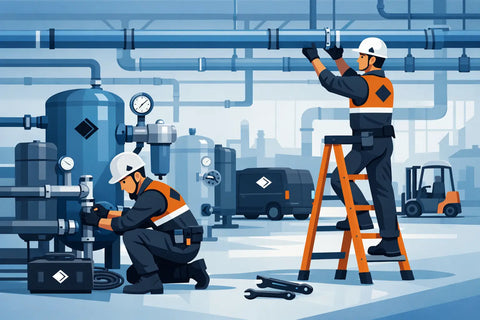
A compressor can be sized correctly, the dryer can be properly selected, and the controls can be dialed in - but if the industrial air piping installation is poorly planned, the whole system underperforms. That usually shows up as pressure drop at the point of use, excess moisture, rising energy costs, and maintenance calls that keep coming back.
For plant managers and maintenance teams, piping is not a background detail. It is the delivery system for every cubic foot of compressed air you pay to produce. When the layout, pipe size, materials, and installation quality are right, the system runs cleaner, more efficiently, and with fewer disruptions. When they are not, production pays for it.
Why industrial air piping installation matters so much
Compressed air systems are often judged by the compressor room, but system performance is shaped across the facility. A well-installed piping network helps maintain stable pressure, supports future expansion, and reduces the amount of work the compressor has to do just to overcome avoidable losses.
That matters because compressed air is expensive utility power. Even a small pressure drop can push equipment to work harder, run longer, and consume more electricity than necessary. In facilities with multiple shifts or heavy air demand, the cost impact compounds quickly.
There is also a reliability issue. Poorly designed piping can trap condensate, feed moisture into downstream equipment, and create uneven flow between production areas. Operators may think they have a compressor problem when the real issue is distribution.
What a good installation starts with
The best industrial air piping installation projects start with demand, not pipe. Before any material is ordered, the system should be evaluated around actual flow requirements, operating pressure, duty cycle, peak demand events, and the layout of the plant.
That sounds basic, but it is where many projects go off course. A piping system that works for one production line may fail once a second shift is added or a new machine comes online. Oversimplified sizing decisions can create bottlenecks that are expensive to correct later.
A proper plan also accounts for air quality. If the application involves instrumentation, food production, packaging, coating, healthcare processes, or any sensitive equipment, the piping layout must work with dryers, filters, drains, and treatment equipment as part of one system. Clean air delivery is not just about what happens near the compressor. It depends on how the entire network handles moisture, pressure, and flow.
Material choice depends on the facility
There is no single best piping material for every plant. It depends on the application, environment, budget, and long-term operating goals.
Aluminum piping systems are often a strong choice for compressed air because they are clean, corrosion-resistant, lightweight, and relatively fast to install. They also support system modifications more easily than some traditional materials, which can be valuable in facilities that reconfigure production lines.
Steel may still make sense in certain industrial environments, especially where mechanical durability is a priority or an existing system is being expanded in a compatible way. But untreated steel can introduce corrosion concerns over time, and that affects air quality as well as maintenance.
Copper is used in some applications, though cost can be a limiting factor. Plastic is generally not appropriate for many compressed air systems because of safety and code concerns. Material selection should not be based only on first cost. Service life, leak resistance, cleanliness, and ease of future expansion usually matter more over the life of the system.
Layout decisions that affect performance
Pipe sizing gets a lot of attention, and it should, but layout is just as important. A well-designed loop system often performs better than a simple dead-end run because it allows air to reach points of use from more than one direction. That helps stabilize pressure, especially when demand varies across the facility.
Drop lines should be planned to reduce moisture carryover and support service access. In most installations, that means taking air from the top of the main line and managing condensate intentionally rather than letting it migrate toward equipment. Sloping the mains correctly and placing drains where moisture actually collects can prevent recurring quality issues.
Valving matters too. Isolation valves allow sections of the system to be serviced without shutting down the whole plant. That is a small design detail until a repair is needed during production hours. Then it becomes the difference between a controlled maintenance event and a broader outage.
Common installation mistakes
The most expensive mistakes in industrial air piping installation are often the ones made to save time. Undersized pipe is a common example. It may look acceptable on paper if the design only considers average demand, but it can create major pressure loss during peak load conditions.
Another issue is poor support and alignment. Piping must be mechanically secure and installed to maintain joint integrity over time. Vibration, movement, and thermal conditions all matter. If they are ignored, leaks and premature failures follow.
Condensate management is another frequent weak point. If a system lacks proper drainage strategy, water ends up where it should not be - in tools, valves, cylinders, instrumentation, and product-contact processes. Teams often chase those failures one device at a time instead of correcting the distribution issue causing them.
Then there is the expansion problem. Facilities change. If the piping design leaves no room for additional drops, future equipment, or zoning improvements, every plant change becomes harder and more expensive than it should be.
Installation quality is only part of the job
Even a correctly installed system should be validated before everyone assumes the job is done. Pressure readings across the network, leak checks, drain operation, airflow at critical points, and compressor loading behavior all need to be reviewed under real operating conditions.
This is where turnkey support has real value. When one team handles system design, equipment selection, piping installation, and startup, there is less room for disconnects between what was specified and what actually performs in the field. Certified technicians can also identify supporting issues that are easy to miss, such as an undersized filter, a poorly placed receiver tank, or a control setting that undermines system efficiency.
For many facilities, the smartest approach is not just to install piping, but to treat the project as a system optimization opportunity. If a plant is already investing in distribution upgrades, it makes sense to review compressor capacity, drying, filtration, storage, and maintenance needs at the same time.
When to replace instead of patching
Some older compressed air systems reach a point where repairs stop making financial sense. If the plant has chronic leaks, pressure inconsistency, corrosion, contamination complaints, or recurring production disruptions, patching one section at a time may only extend the problem.
Replacement is usually worth considering when maintenance costs stay high, expansions have made the layout inefficient, or air quality requirements have changed. A newer piping system can improve flow, reduce leakage, simplify service access, and support better zoning across the facility.
That does not mean every old system needs a full rip-and-replace. Sometimes a phased upgrade is the better decision, especially in active plants where shutdown windows are limited. It depends on the condition of the existing infrastructure, the production schedule, and the cost of downtime during installation.
What to expect from the right installation partner
An experienced compressed air partner should do more than hang pipe. They should evaluate load requirements, identify pressure drop risks, recommend appropriate materials, coordinate around plant operations, and build the system for maintainability.
That includes clean installation practices, accurate system labeling, proper support spacing, isolation planning, and startup verification. It also includes the ability to service the system after the project is complete. Installation is one phase. Long-term performance is the real outcome that matters.
For facilities in uptime-critical industries, speed matters, but shortcuts do not. The right contractor understands that production schedules, safety requirements, and future expansion plans all have to be part of the install strategy. That is especially true in busy industrial markets where shutdown time is expensive and delays affect more than one department.
If you are planning an industrial air piping installation, the goal is not just to get air from one end of the building to the other. The goal is stable pressure, clean delivery, lower waste, and a system that supports production without becoming the next maintenance problem. A well-built piping network does that quietly every day, which is exactly how it should work.
