
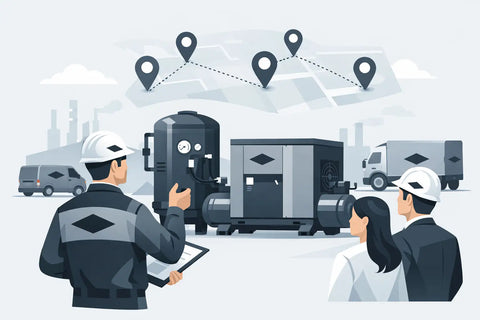
A plant can lose a full shift over something as small as a failed drain, a neglected filter, or a compressor that was never sized correctly in the first place. That is why a search for a manufacturing compressor dealer near me is rarely just about finding a box with a motor. It is about finding a partner that can keep air flowing, stabilize production, and respond fast when uptime is on the line.
For manufacturing facilities, compressed air is not a side utility. It is part of the process. When the system is unreliable, everything downstream feels it - scrap rates, cycle times, labor efficiency, and delivery commitments. The right dealer helps you avoid those problems before they become expensive.
What a manufacturing compressor dealer near me should actually provide
A dealer serving manufacturers should do more than quote equipment. You need a source for system design, installation, parts, repairs, rentals, and preventative maintenance. If those functions are split across multiple vendors, accountability gets blurry fast.
In practice, manufacturers usually need one of two things. Either they are replacing a failed compressor under pressure, or they are trying to improve a system that has been wasting energy and creating reliability issues for years. A dealer worth calling can handle both situations without treating every job like a simple equipment sale.
That means asking the right questions early. What is the actual demand profile? Is air quality part of the process requirement? Are there pressure drops across the plant? Is the current piping layout creating restrictions? A dealer that skips these basics may still sell you a compressor, but that does not mean the system will perform well after startup.
Equipment matters, but support matters more
Most manufacturing teams already understand that compressor quality matters. Brand reputation, efficiency, controls, and expected service life all play a role. But over time, support usually has a larger effect on total cost than the nameplate alone.
A lower-priced machine can become an expensive choice if parts are hard to get, service response is inconsistent, or startup and commissioning are handled poorly. On the other hand, a well-supported system often delivers better reliability and lower operating costs even if the upfront purchase price is higher.
This is where authorized dealer relationships matter. Access to major compressor brands helps, but the real value is proper application support, genuine parts availability, warranty alignment, and technicians who know the equipment. For plants with mixed equipment across multiple brands, it also helps to work with a provider that can service more than one platform instead of forcing everything into a single brand conversation.
How to evaluate a local dealer without wasting time
If you are comparing providers, the fastest way to narrow the field is to focus on operational capability rather than marketing claims. Ask how they support the full lifecycle of the system. Can they size and specify equipment correctly? Can they install piping, dryers, filters, and treatment equipment as part of one project? Can they provide emergency service when production is down?
It also helps to ask who will actually do the work. Certified technicians, stocked service vehicles, and regional parts availability are not small details. They determine whether a repair takes hours or days.
For many manufacturers, preventive maintenance is another dividing line. A dealer that can build a maintenance plan around run hours, service intervals, and known wear components will usually save you more than a dealer that only shows up after a breakdown. Reactive service has a place, but it should not be the whole strategy.
Questions worth asking before you buy
When evaluating a manufacturing compressor dealer near me, ask practical questions tied to plant performance. How quickly can they respond to an emergency call? Do they stock common replacement parts? Can they support dryers, filters, separators, and vacuum equipment along with compressors? Do they offer rental support during a failure or planned shutdown?
Also ask how they approach system efficiency. Compressed air costs are often hidden inside the utility bill, which is why leaks, poor controls, and oversized equipment can go unchallenged for years. A capable dealer should be able to identify where energy is being lost and whether changes in controls, storage, piping, or treatment would improve the system.
The biggest mistake buyers make
The most common mistake is buying around the compressor instead of buying around the application. In manufacturing, the compressor is only one part of the system. Storage, air treatment, controls, distribution piping, condensate management, and maintenance planning all affect results.
A plant may install a new compressor and still have pressure instability because the real issue was undersized piping or neglected filtration. Another facility may blame the compressor for poor tool performance when the actual cause is moisture contamination or pressure drop at the point of use. These are expensive mistakes because they look like equipment problems but are really system problems.
The better approach is to evaluate the compressed air system as infrastructure. That mindset usually leads to better sizing, cleaner installation, and fewer surprises after commissioning.
Service response is part of the purchase
Manufacturing buyers often focus heavily on capital cost during the quote stage, then shift attention to service only after something goes wrong. By then, your options are limited.
A compressor dealer should be judged partly on what happens after the sale. If a unit trips out during production, can the provider troubleshoot quickly? If a dryer fails and product quality is at risk, do they have the parts and technical depth to restore the system fast? If a facility is expanding, can they integrate new capacity without disrupting current operations?
These questions matter more in high-demand environments such as food processing, medical manufacturing, defense, packaging, plastics, and general industrial production. In those settings, downtime compounds quickly. Lost output, idle labor, delayed shipments, and expedited fixes can exceed the original equipment cost faster than many teams expect.
Why one-source support usually wins
There is a reason many facilities prefer a single provider for equipment, service, parts, and installation. It reduces handoffs. When one company is responsible for design, startup, maintenance, and repair, there is less room for finger-pointing.
That does not mean every situation requires one-source support. Some larger organizations have in-house engineering teams and established contractor networks. But even then, a dealer with turnkey capability can simplify execution, especially during expansions, retrofit projects, or time-sensitive replacements.
For example, a manufacturer upgrading a legacy compressed air room may need a new compressor, dryer package, filtration, condensate treatment, controls, and piping modifications at the same time. Managing separate vendors for each scope can slow the project and create compatibility issues. A provider that can engineer and execute the full package usually reduces risk.
Companies like Advanced Air & Vacuum are built around that model - equipment access, technical service, installation, parts support, and long-term maintenance through one operational partner.
Local matters when the system is critical
The phrase near me can sound basic, but in industrial service it has real meaning. Proximity affects emergency response, technician availability, startup scheduling, and parts delivery. For facilities in Southern California and Arizona, regional coverage is not just convenient. It can directly affect recovery time during an outage.
That said, local presence alone is not enough. A nearby dealer without depth is still a weak option. What you want is local responsiveness backed by technical capability, inventory access, and the ability to support both planned projects and unexpected failures.
A better way to choose
If you are searching for a manufacturing compressor dealer near me, do not stop at who can quote fastest. Look for who can keep the system running six months from now, during the next expansion, and in the middle of a shutdown call at 2 a.m. Equipment matters. Service response matters. Parts access matters. System design matters.
The strongest dealer relationship is the one that lowers risk across all of them.
A reliable compressed air partner should make your operation easier to run, not harder to manage. If a provider can help you source the right equipment, install it correctly, maintain it proactively, and respond when production is on the line, you are not just buying a compressor. You are buying stability where your plant needs it most.
