
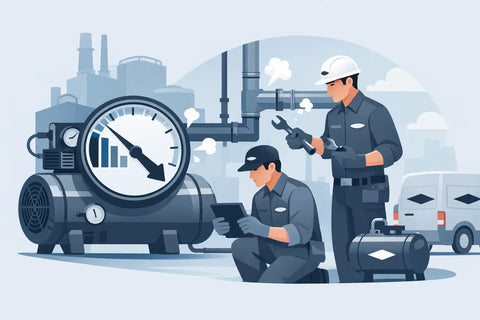
Low air pressure rarely shows up at a convenient time. It usually appears when a line is running hard, a critical tool starts underperforming, or operators begin reporting inconsistent output across the plant. If you are asking what causes low air pressure, the real issue is usually not just pressure itself. It is a system problem somewhere between air generation, storage, treatment, distribution, and point-of-use demand.
In industrial facilities, low pressure is not one single fault with one single fix. It can come from undersized equipment, poor piping design, neglected maintenance, excessive demand, hidden leaks, or controls that are not set up for the way the plant actually runs. The fastest path to a solution is to treat pressure loss like an operational diagnosis, not a guess.
What causes low air pressure in a compressed air system?
At a high level, low air pressure happens when supply cannot keep up with demand, or when pressure is being lost before it reaches the point of use. That sounds simple, but the cause can sit in several different places.
Sometimes the compressor is working properly, but restrictions in dryers, filters, separators, or piping are choking flow. In other cases, the compressor itself is not producing enough capacity because of wear, incorrect settings, or a control problem. And in many plants, the issue is more situational than mechanical. A system may hold pressure during normal shifts, then fall off when multiple machines cycle on at once.
That is why pressure complaints need context. The pressure at the compressor discharge may look fine, while the pressure at the far end of the building is too low to support production.
The most common causes of low air pressure
Air leaks are draining capacity
Leaks are one of the most common reasons system pressure drops. A few small leaks may not seem urgent, but in a production environment they add up quickly. When the compressor has to feed open demand that serves no process purpose, available pressure at actual equipment can suffer.
Leaks often occur at fittings, quick-connects, flexible hoses, drains, valves, and old branch lines that were added over time. The problem gets worse in facilities where compressed air use has expanded, but leak repair never became a routine maintenance item.
The trade-off here is straightforward. Raising system pressure to overcome leak-related drop may help temporarily, but it usually increases energy cost and can make leakage volume even worse.
Filters and dryers are creating pressure drop
Air treatment equipment protects downstream machinery, but only when it is maintained properly. A clogged filter element or overloaded dryer can restrict airflow enough to create a noticeable pressure drop across the system.
This is especially common when differential pressure indicators are ignored or replacement intervals are stretched too far. Plants sometimes focus on compressor maintenance while overlooking the treatment train, even though that is often where avoidable pressure loss builds up.
If pressure is healthy upstream and weak downstream, filters and dryers should move high on the inspection list.
Demand has outgrown the original system design
A compressed air system that worked five years ago may not be adequate today. Added machines, new shifts, process changes, and increased production targets can all increase air demand beyond what the compressor room was designed to support.
This issue is common in growing facilities because demand does not usually increase in one obvious step. It grows gradually. A few new drops here, another packaging line there, more blow-off use, more pneumatic valves, more tools. Eventually the system reaches a point where pressure starts falling during peak demand windows.
In that case, low pressure is not a repair issue alone. It is a capacity planning issue.
Compressor controls or setpoints are incorrect
Low pressure can come from control settings that do not match plant requirements. The compressor may be set too low, sequenced poorly with other machines, or cycling in a way that fails to maintain stable pressure under varying load.
In multi-compressor systems, poor coordination is a frequent cause of unstable pressure. One machine may be carrying too much of the load while another starts too late, unloads too early, or fights the lead machine. The result is pressure fluctuation that shows up on the production floor before it is obvious in the compressor room.
This is one reason controls review matters. The problem may not be lack of horsepower. It may be how available capacity is being managed.
Piping is undersized, restrictive, or poorly laid out
Distribution losses are often overlooked because the compressor gets the blame first. But long pipe runs, undersized headers, excessive elbows, dead ends, and poorly planned branch lines can all create pressure loss before air reaches the point of use.
Facilities that evolved in phases are especially vulnerable to this. A system may have been expanded in sections without reworking the backbone piping. That can leave bottlenecks in place that only show up when several departments pull air at once.
Point-of-use complaints at one side of a facility do not always mean the whole system is underperforming. Sometimes the issue is local to that section of piping.
Compressor components are worn or failing
If the compressor itself is not producing as designed, system pressure will eventually drop. Intake filters, valves, separators, belts, coolers, and internal airend components can all affect delivered performance.
Wear does not always cause a complete shutdown. More often, it reduces efficiency and output gradually. That is why pressure problems can seem to appear out of nowhere even though the machine has been losing performance over time.
A unit that is running is not necessarily a unit that is producing full capacity.
Storage is inadequate for demand swings
Receiver tanks help stabilize pressure when demand changes quickly. Without enough storage, even a healthy compressor can struggle to keep pressure steady during sudden air events such as large cylinders actuating, baghouse pulses, or production equipment starting in sequence.
This is an area where the answer depends on the application. Some systems have enough compressor capacity on paper, but not enough storage to buffer real-world demand patterns. In those cases, the complaint is low pressure, but the root issue is poor system stability.
How to diagnose what causes low air pressure
The most effective troubleshooting starts with one question: where is pressure low? If pressure is low everywhere, the issue usually points toward supply, controls, major leaks, or overall capacity. If pressure is low only at certain machines or in certain shifts, restrictions or localized distribution problems become more likely.
Start by comparing pressure readings at key points in the system. Check compressor discharge pressure, receiver pressure, pressure before and after filters and dryers, and pressure at the point of use. Those readings help isolate whether air is being lost in generation, treatment, distribution, or end use.
It also helps to look at timing. Does pressure drop only during peak production? Only on hot days? Only when a backup compressor is offline? Patterns matter. A pressure problem tied to load profile usually needs a different fix than one caused by a dirty filter or failing valve.
For plants with recurring pressure complaints, data logging can be far more useful than spot checks. Pressure, flow, and compressor status trends often reveal issues that are easy to miss during a quick walk-through.
What causes low air pressure at the point of use?
When the compressor room looks normal but tools or equipment still see low pressure, focus on the last segment of the system. Regulators may be set too low or may be failing. Hoses may be too small or too long for the application. Quick-connects and point-of-use filters may be adding more restriction than expected.
This is common with high-demand tools and process equipment. A machine may be rated for a certain pressure, but if the local air delivery components cannot support the required flow, effective pressure at the machine drops under load.
That is why point-of-use pressure should never be judged only at idle.
Preventing pressure loss before it becomes downtime
The best way to avoid low pressure is to manage the compressed air system as production infrastructure, not just utility equipment. Preventive maintenance on compressors, filters, dryers, drains, and separators reduces avoidable pressure loss. Leak surveys protect capacity you are already paying to generate. System reviews help confirm that piping, storage, and controls still match actual demand.
For facilities with growth plans, this matters even more. A system that is barely meeting demand today will not be reliable six months from now. Pressure issues tend to become production issues fast.
In many cases, the right answer is not one repair. It is a combination of maintenance, control adjustment, leak correction, and system design improvement. That is where an experienced compressed air partner can make a measurable difference, especially when uptime is tied directly to output.
If low air pressure keeps showing up in your plant, treat it as an early warning sign. Small pressure losses have a way of turning into wasted energy, unstable operations, and avoidable downtime long before the system actually fails.
