
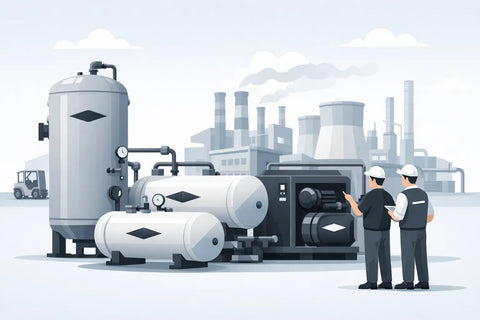
A compressor can have enough rated capacity and still leave production short on air. The problem is often not the compressor itself. It is a system that cannot absorb short, high-demand events, stabilize pressure, or remove the moisture created during compression. This industrial compressed air storage guide explains how air receivers work, where they belong, and how to size them for reliable plant operation.
Compressed air storage is not a tank added as an afterthought. Properly selected receivers reduce compressor cycling, support peak demand, improve moisture management, and give operations teams more control over pressure. Poorly selected storage can do the opposite, masking pressure-drop problems or allowing water contamination to reach equipment.
What Compressed Air Storage Does
An air receiver stores compressed air as usable capacity between the compressor and the point of use. When a process suddenly needs more air than the compressor can immediately provide, the receiver supplies that demand for a limited time. That cushion keeps system pressure from falling below the level required by production equipment.
Storage also gives compressed air a chance to cool. As air cools, water vapor condenses. A properly drained receiver can remove a meaningful portion of bulk liquid water before the air reaches dryers, filters, piping, valves, and tools. This does not replace air treatment, but it reduces the moisture burden on downstream equipment.
For plants with intermittent demand, storage can reduce rapid load-unload cycling and frequent starts. That matters because excessive cycling wastes energy and adds wear to motors, controls, contactors, and compressor components. Storage is especially useful when a facility has high-volume, short-duration events such as blowoff, packaging, pulse cleaning, actuators, bagging equipment, or material handling.
Wet Receivers and Dry Receivers Have Different Jobs
The most effective systems commonly use storage on both sides of the dryer. The receiver location determines what problem it helps solve.
Wet Storage Before the Dryer
A wet receiver is installed downstream of the compressor and upstream of the dryer. It receives hot, moisture-laden air directly from compression. Its main purpose is to provide initial storage, stabilize compressor operation, and collect condensate after the air begins to cool.
This location can reduce the peak flow seen by the dryer. Instead of forcing the dryer to respond to every brief surge in demand, the wet receiver supplies some of that air. That can improve dryer performance, particularly in systems with fluctuating demand.
A wet receiver must have a properly functioning automatic drain. Manual draining is rarely consistent enough for an operating plant. If condensate accumulates, storage volume falls, corrosion risk rises, and water can be pushed downstream during demand events.
Dry Storage After the Dryer
A dry receiver is installed after the air dryer and final filtration. It holds treated air close to the distribution system or a high-demand production area. This is often the best location for protecting pressure at the point of use during sudden demand spikes.
Dry storage is particularly valuable when the main compressor room is far from the production line, when piping has measurable pressure drop, or when individual processes create short bursts of demand. It provides immediate local capacity without requiring the compressor to chase every fluctuation.
The trade-off is cost and space. A plant does not always need two receivers. Systems with steady demand and short pipe runs may perform well with one correctly sized wet receiver. Systems with variable demand, sensitive equipment, or long distribution runs often benefit from both.
Size Storage Around Demand, Not Compressor Horsepower
Receiver sizing is frequently based on a generic gallons-per-cfm rule. That can be a useful starting point, but it is not a final design method. The right storage volume depends on the demand event, the acceptable pressure swing, compressor capacity, control strategy, and air quality requirements.
Start by identifying the event that creates the problem. Is it a 30-second packaging cycle? A five-minute blast-cleaning operation? A pulse demand that repeats every few seconds? Record actual system pressure before, during, and after the event. If pressure falls sharply while the compressor is already operating at full output, the system may need additional capacity, reduced demand, or both.
A common engineering approach calculates receiver volume from required flow, event duration, and allowable pressure drop. In simplified form:
`Receiver volume = (Required flow × time × 14.7) ÷ allowable pressure difference`
Use absolute pressure values when applying a detailed calculation, and use consistent units throughout. Because compressor controls, flow measurement, temperature, and pressure losses affect the result, this calculation should be treated as a design tool rather than a field shortcut.
For example, if a production line needs a large burst of air for a short period but can tolerate only a small pressure drop, it will need more storage than a line with the same flow demand and a wider acceptable pressure range. Raising system pressure just to compensate for inadequate storage is usually an expensive workaround. Higher pressure increases energy consumption and can worsen leakage rates.
Place Receivers Where They Solve the Pressure Problem
A large receiver in the compressor room cannot always correct a pressure drop at the far end of a facility. If the bottleneck is undersized piping, restrictive filters, poorly selected regulators, or a long run serving a high-flow machine, storage alone will not fix it.
Review pressure at several points: compressor discharge, after treatment, at the main header, and at the critical point of use. A pressure profile reveals whether the issue is total system capacity or distribution loss. If pressure is stable at the compressor but unstable at a machine, local dry storage and piping improvements may be more effective than adding capacity at the compressor.
Point-of-use receivers are often practical for isolated high-demand equipment. They should be installed with appropriate isolation valves, drains, pressure relief protection, and access for inspection. Avoid creating a storage arrangement that cannot be safely drained or serviced.
Storage Does Not Replace Air Treatment or Leak Control
A receiver can help a plant ride through demand peaks, but it does not create air quality. Dryers, filters, condensate management, and routine maintenance remain necessary. The correct treatment train depends on the application, required pressure dew point, oil tolerance, ambient conditions, and contamination risk.
For food, beverage, pharmaceutical, electronics, paint, and instrument-air applications, air quality requirements can be more demanding than general manufacturing requirements. In those cases, receiver location and internal tank condition deserve added attention. Contamination in a neglected receiver can undermine the performance of otherwise well-selected treatment equipment.
Leaks are another common issue. Adding storage may make a leaking system appear more stable for a short period, but the compressor will still run longer to replace wasted air. If unload time declines, run hours rise, or pressure is low during off-shift periods, schedule a leak survey before investing in larger storage.
Receiver Maintenance Protects Capacity and Safety
Air receivers are pressure vessels and should be treated accordingly. Inspect the vessel exterior for corrosion, damaged fittings, signs of leakage, and unreadable safety markings. Verify that pressure relief valves are correctly sized, installed, and maintained. Do not isolate or plug a relief valve.
Automatic drains deserve regular attention. A drain that sticks closed allows water to accumulate. A drain that sticks open wastes compressed air. Test drains, clean strainers, and confirm that discharge is routed safely and in compliance with facility requirements.
Maintenance teams should also document operating pressure, drain performance, temperature, and visible corrosion. Internal corrosion can be difficult to detect until it becomes serious, especially in wet receivers with poor condensate management. Follow applicable inspection requirements and manufacturer guidance for your vessel and jurisdiction.
Build Storage Into a Complete System Plan
The best storage decision comes from system data, not tank size alone. Measure demand, review compressor controls, inspect treatment equipment, and identify pressure loss across the distribution network. A receiver may be part of the answer, but the complete solution could also involve control changes, dryer upgrades, piping corrections, leak repair, or additional compressor capacity.
For Southern California and Arizona facilities managing production-critical air, Advanced Air & Vacuum can help evaluate storage as part of a complete compressed air system plan. The right receiver arrangement should give your team a measurable result: steadier pressure, better air quality protection, lower cycling, and fewer production interruptions.
When pressure instability starts affecting output, do not wait for a compressor failure to investigate. A focused storage and system assessment can turn recurring air complaints into a clear corrective plan.
