
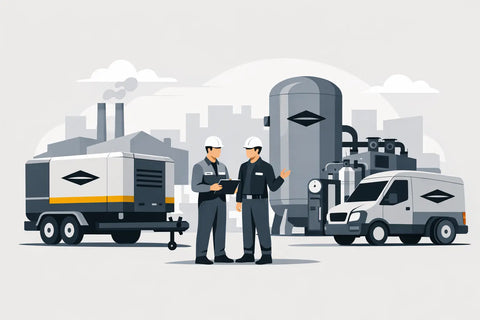
A failed compressor can stop a production line long before a replacement unit arrives. When air supports controls, packaging, tools, conveying, wastewater treatment, or critical process equipment, waiting through a repair or capital approval is not a workable plan. Compressed air system rentals give operations teams a practical way to maintain air supply while they resolve the underlying equipment need.
Rental equipment is not only for emergencies. It can support a scheduled overhaul, a seasonal production increase, a plant expansion, or a short-term project where buying permanent equipment does not make financial sense. The value is simple: keep production moving with correctly sized, properly treated air instead of accepting downtime, waste, and rushed decisions.
When Compressed Air System Rentals Are the Right Move
The clearest use case is an unplanned compressor failure. If a primary unit goes down and installed backup capacity cannot carry the required load, temporary air can bridge the gap while certified technicians diagnose the issue, source parts, or coordinate a repair. For facilities with one aging compressor and no true redundancy, a rental can prevent an equipment failure from becoming a production shutdown.
Planned maintenance is another common reason to rent. Air ends, motors, controls, dryers, and major piping components occasionally need work that cannot be completed during a normal shift. Bringing in rental capacity before the work begins lets maintenance teams take equipment offline without gambling on reduced production or poor air quality.
Rentals also make sense when demand is temporary. A contract manufacturer may add a shift for several months. A beverage operation may need more capacity during peak season. A construction, municipal, or defense-related project may require dependable air at a location without permanent infrastructure. In these situations, purchasing a large compressor for a short-duration need can tie up capital and leave the facility with underused equipment later.
A rental is not always the best answer. If demand has permanently increased, or if the existing system is consistently undersized and inefficient, a properly engineered permanent installation is usually the stronger long-term investment. The rental period can still be valuable, however, because it buys time to evaluate the actual load profile and select the right replacement system without pressure.
Start With Air Demand, Not Compressor Horsepower
The fastest way to get the wrong rental is to request a compressor based only on horsepower. Horsepower matters, but it does not tell the full story. The rental system must deliver the required airflow at the operating pressure your facility actually needs.
Start by identifying your average and peak air demand in cubic feet per minute, or CFM. Peak demand matters because short bursts from baggers, blow-off stations, pneumatic tools, actuators, or other equipment can pull system pressure down even when average use appears manageable. If pressure drops below what the process requires, the result may be rejected product, slow machine cycles, failed controls, or unnecessary operator intervention.
Also confirm the pressure requirement at the point of use, not just the compressor discharge setting. A facility may run the compressor at 125 psi to compensate for undersized piping, clogged filters, leaks, or excessive pressure drop. Temporary equipment should be sized around the application while the rental provider evaluates whether those system issues should be corrected.
A qualified rental assessment should account for production schedule, current compressor capacity, backup equipment, receiver storage, pipe size, connection points, electrical availability, ambient conditions, and expected rental duration. That information determines whether you need one compressor, multiple units, a portable diesel package, additional storage, or a complete temporary air system.
Air Quality Equipment Is Part of the Rental System
Compressed air that reaches the required pressure is not automatically suitable for the application. Moisture, oil carryover, particulate, and condensate can create as much trouble as a lack of airflow. This is especially relevant for food and beverage, healthcare, electronics, painting, pharmaceutical-adjacent processes, instrumentation, and any operation where air contacts product or sensitive equipment.
A complete rental solution may include an air compressor, refrigerated or desiccant dryer, coalescing filters, particulate filters, water separators, drains, and storage receivers. The right package depends on the air quality target and the process risk. A general maintenance application may tolerate conditions that would be unacceptable for packaging or precision controls.
Dryer selection deserves particular attention. Refrigerated dryers are often suitable for general industrial use where a moderate pressure dew point is acceptable. Desiccant dryers are used when the application requires much drier air, including environments with low ambient temperatures or processes that cannot tolerate moisture. The trade-off is that higher air quality requirements can add equipment, energy use, and setup complexity.
Do not assume temporary equipment can bypass the facility's existing treatment train without review. Existing filters may be saturated, undersized, or not rated for the rental flow. Likewise, a rental compressor connected upstream of an overloaded dryer may maintain pressure while introducing moisture-related quality problems. Temporary air should be treated as a system, not a compressor dropped at the curb.
Plan the Connection and Power Before Delivery
A rental succeeds or fails on site preparation. Before equipment arrives, confirm where it will sit, how it will connect, and what it will require to operate safely. Portable units need a stable location with adequate access for delivery, service, ventilation, and fuel support when applicable. Stationary electric rental equipment needs verified voltage, phase, available amperage, and properly sized disconnects.
Connection piping must be able to carry the rental flow without creating excessive pressure drop. A temporary hose run may be convenient, but long, undersized runs can restrict airflow and force the compressor to operate at a higher pressure than necessary. That increases energy use and can still leave the plant short at the point of use.
Consider condensate management as well. Compressors and dryers generate condensate that must be drained and handled correctly. Depending on the equipment and local requirements, oil-water separation may be needed before discharge. A temporary installation should meet the same operating and environmental expectations as the permanent system.
For outdoor rentals in Southern California and Arizona, heat and dust also deserve attention. High ambient temperatures reduce compressor performance and place added demands on cooling systems. A poorly located unit can recirculate hot discharge air, ingest dust, or become difficult to service. Proper placement helps protect both rental performance and uptime.
Compare Rental Cost Against the Cost of Stopping
The daily or monthly rental rate is only one part of the decision. The more useful comparison is between rental cost and the cost of interrupted production. Lost output, labor standing by, missed delivery windows, overtime recovery, spoiled materials, and customer penalties can quickly exceed the cost of temporary air equipment.
That said, cost control still matters. Ask for a clear scope that identifies the equipment included, delivery and pickup, installation support, fuel or electrical requirements, hoses or temporary piping, air treatment, planned service, and emergency response expectations. A lower equipment rate can become more expensive if essential accessories or support are excluded.
The rental term matters too. For a short emergency repair, speed and availability may outweigh every other consideration. For a multi-month project, evaluate operating efficiency, maintenance coverage, and whether a rental-credit or purchase option is available. The best choice depends on duration, production risk, and the facility's future capacity plan.
Use the Rental Period to Improve the Permanent System
A temporary air package can reveal problems that were hidden by an aging or undersized installed system. If the rental compressor consistently runs at a lower pressure while production remains stable, the plant may have been over-pressurizing to overcome leaks or restrictions. If the rental package struggles during certain shifts, the facility may have peak-demand events that require storage, controls, or distribution changes rather than simply more compressor horsepower.
This is a useful time to review leakage, pressure drop, air quality, drain performance, and maintenance history. It can also help operations teams document actual demand before committing capital to a new compressor, dryer, piping system, or automation upgrade. Advanced Air & Vacuum can support that process with equipment access, certified technicians, installation capability, and ongoing maintenance planning.
Before the next outage forces a rushed decision, identify your required CFM, pressure, air quality, power source, and connection plan. A properly planned rental keeps temporary equipment from becoming temporary chaos - and gives your team the time to make the right long-term decision.
