
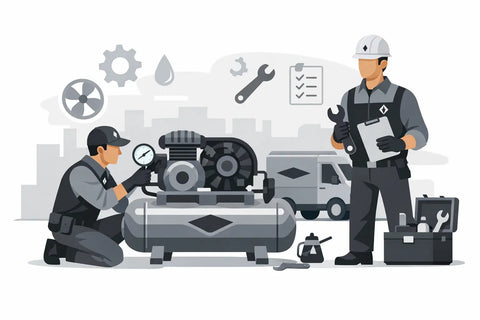
A compressor rarely fails at a convenient time. It fails during a production run, before a shipment, or when a facility is already stretched thin. That is why air compressor preventive maintenance is not just a maintenance task - it is an uptime strategy.
For plants, hospitals, breweries, municipalities, and other operations that depend on clean, stable compressed air, small service issues turn into larger system problems fast. A neglected filter can raise pressure drop. A missed oil change can shorten element life. A drain that sticks open can waste air around the clock. Preventive maintenance keeps those problems from becoming expensive interruptions.
Why air compressor preventive maintenance matters
Compressed air systems are easy to underestimate because most of the system is working in the background. Operators see the end use point. Maintenance teams hear the compressor room. What they do not always see right away is the cost of poor performance.
When maintenance slips, the first impact is often efficiency. The compressor runs longer to deliver the same output. Dryers and filters work harder. Pressure becomes less stable. In many facilities, that shows up as rising power bills before it shows up as a shutdown.
The second impact is reliability. Heat, contamination, moisture, and vibration do cumulative damage. Bearings wear faster. Oil quality drops. Belts loosen. Electrical connections degrade. A machine that could have stayed in service with routine attention ends up needing a major repair.
There is also the product and process side. In food and beverage, healthcare, electronics, and precision manufacturing, air quality matters as much as volume. Moisture carryover, oil contamination, or inadequate filtration can affect product quality, tooling, controls, and compliance.
The maintenance schedule should match the system
Not every compressor needs the same service interval. That depends on the compressor type, the operating environment, the duty cycle, and the criticality of the application. A lightly used shop compressor does not have the same maintenance profile as a rotary screw unit supporting multiple production lines in a hot, dusty plant.
That is why calendar-based maintenance alone is usually not enough. Run hours matter. Load profile matters. Ambient conditions matter. A system with high summer temperatures, heavy particulate exposure, or frequent demand swings may need more frequent inspection than the manual's baseline recommendation.
For many facilities, the right approach is a planned schedule built around manufacturer guidelines, actual operating conditions, and the performance of the complete compressed air system - not just the compressor package itself.
What to check during routine air compressor preventive maintenance
Some maintenance items are straightforward, but they still get missed when teams are busy. Daily and weekly checks help catch obvious issues before they build. That includes reviewing discharge temperature, pressure readings, fluid level, condensate drains, and any alarms or unusual vibration.
Filters deserve close attention. A clogged air intake filter restricts airflow and forces the compressor to work harder. An overloaded inline filter creates pressure drop that can affect downstream equipment. In both cases, the system may still be running, but not efficiently.
Lubricated compressors also depend on clean, correctly specified fluid. Oil that is overdue for service loses its ability to protect internal components and carry heat away effectively. Changing oil, oil filters, and separators at the right intervals is basic maintenance, but it has a direct effect on equipment life.
Belts, couplings, hoses, and fittings should also be inspected for wear and proper tension or alignment. These are not high-profile components, but they often signal bigger issues. A worn belt may point to alignment problems. A damaged hose may suggest vibration or heat exposure. A leaking fitting may be part of a larger system-wide air loss problem.
On the electrical side, preventive maintenance should include checking terminals, contactors, overloads, and control panel condition. Loose connections create heat. Heat creates failure. That chain is common, preventable, and expensive when it is ignored.
Do not stop at the compressor room
One of the most common mistakes in air compressor preventive maintenance is focusing only on the machine and ignoring the rest of the system. Compressed air performance depends on the dryer, filters, drains, receivers, piping, and controls as much as it does on the compressor itself.
If the dryer is not operating properly, moisture moves downstream. If drains are plugged or failed, condensate stays in the system. If filters are undersized or overdue for replacement, pressure drop increases. If piping has leaks or poor layout, the compressor compensates by running harder and longer.
This is where many facilities lose money without realizing it. The compressor may be healthy, but the system is not. A good maintenance program looks at air treatment and distribution together so the plant gets stable pressure, clean air, and efficient operation.
The hidden cost of delaying service
Teams often postpone maintenance because the compressor is still running. From an operations standpoint, that can feel reasonable in the moment. The problem is that compressed air equipment usually gives warning signs before failure, and those signs are easy to normalize.
A slight increase in temperature, a little more oil carryover, slower dryer performance, more frequent loading, or a small leak may not stop production today. But each one adds cost. Energy waste accumulates quietly. Wear accelerates. Emergency repair risk increases.
Emergency service has its place, especially for critical facilities, but it is almost always the most expensive way to manage a system. Unplanned downtime affects labor, output, shipping, and customer commitments. In some environments, it can also create safety or compliance concerns.
Preventive maintenance shifts the conversation from reacting to failures to controlling risk. That is a better position for plant managers, maintenance supervisors, and procurement teams alike.
Why documentation matters as much as service
A maintenance program is only as useful as the records behind it. If there is no clear service history, it becomes harder to track recurring issues, forecast parts usage, or make informed replacement decisions.
Good documentation should show run hours, service dates, parts replaced, fluid changes, filter changes, readings, alarms, and technician notes. Over time, those records help identify whether a compressor is operating normally, whether a dryer is becoming unreliable, or whether a chronic pressure issue is actually tied to demand growth or distribution losses.
This also helps with budgeting. Planned service is easier to forecast than emergency capital expense. When maintenance records are complete, facilities can time repairs, upgrades, and replacements with less disruption.
When in-house maintenance is enough and when it is not
Some facilities have strong internal maintenance teams that handle routine inspection and basic service well. That can be effective, especially when the equipment mix is familiar and the application is not highly specialized.
But there are trade-offs. Multi-compressor systems, variable speed controls, air quality requirements, and integrated treatment equipment often need deeper system knowledge. The same is true when different brands are installed across a site or when recurring problems have not been solved by standard service.
In those cases, certified technicians bring value beyond parts replacement. They can evaluate system performance, verify control strategy, identify avoidable pressure drop, and spot problems that may not be obvious during a basic inspection. For facilities in Southern California and Arizona where uptime is closely tied to production demands and environmental conditions, that kind of proactive support can prevent repeat failures.
Building a preventive maintenance plan that works
The best maintenance plan is practical enough to follow and specific enough to matter. It should account for compressor type, critical spare parts, lead times, production windows, and the air quality needs of the process.
It should also define who is responsible for what. Operators can often handle daily observations. Internal maintenance teams may manage routine inspections and minor tasks. Outside service support may be better suited for scheduled PMs, diagnostics, oil analysis, control checks, dryer service, and larger repairs. The point is not to hand everything off or keep everything in-house. The point is to create coverage without gaps.
At Advanced Air & Vacuum, that preventive approach is part of how long-term compressed air reliability gets managed in the field - not with guesswork, but with planned service, system visibility, and support that matches the application.
If your compressor only gets attention after an alarm or breakdown, that is usually the first sign the maintenance strategy needs attention too. A well-maintained system runs cleaner, costs less to operate, and gives your team fewer surprises when the pressure is on.
