
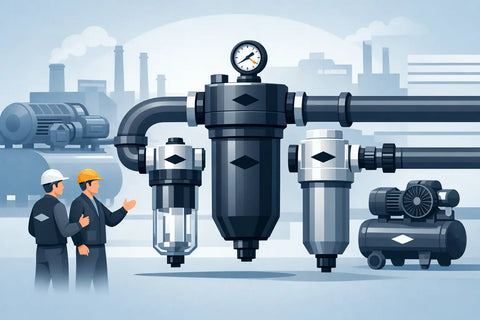
A filter that looks clean can still be costing a facility money. As its media loads with contaminants, pressure drop rises, compressors work harder, and downstream equipment receives less reliable air. Choosing the best inline air filters industrial facilities need is not about buying the highest-rated element on the shelf. It is about matching filtration performance, flow capacity, installation location, and maintenance requirements to the process that depends on the air.
For plant managers and maintenance teams, the right decision protects more than the compressor. It protects product quality, pneumatic tools, control valves, instrumentation, dryers, and production uptime.
What Makes an Inline Air Filter the Right Choice?
Industrial compressed air carries more than air. It can contain atmospheric dust pulled in at the compressor inlet, pipe scale, rust, condensed water, lubricant aerosols, and vapor. The contaminant mix changes with the compressor type, operating environment, piping condition, and treatment equipment already installed.
An inline filter is installed directly in the compressed air path to remove a defined class of contaminants before the air reaches sensitive equipment or a critical process. The best choice begins with one question: what must be removed, and how clean does the air need to be at the point of use?
A general manufacturing line using pneumatic cylinders does not need the same air quality as a hospital application, food and beverage packaging line, paint operation, laboratory, or electronics process. Over-filtering every branch can create unnecessary pressure drop and replacement costs. Under-filtering can lead to damaged tools, rejected product, corrosion, and unplanned shutdowns.
The practical objective is clean, stable air at the lowest sustainable operating cost.
Best Inline Air Filters Industrial Systems Commonly Use
Most industrial compressed air systems rely on a staged filtration approach rather than one filter doing every job. Each stage has a purpose, and the order matters.
Particulate Filters for Solids and Pipe Debris
Particulate filters capture solid contaminants such as dust, rust, pipe scale, and desiccant fines. They are often placed downstream of a dryer, especially where desiccant dryer dust could travel into production lines. They may also be used near a point of use when local air cleanliness requirements are higher than the rest of the facility.
A particulate filter is not a substitute for a coalescing filter where oil aerosol is present. It is designed primarily for dry solids. Selecting too fine a particulate grade without a real process requirement can increase restriction without solving an actual contamination problem.
Coalescing Filters for Oil Aerosol and Fine Particles
Coalescing filters are central to many industrial air treatment systems. Their media captures fine particulate and oil aerosols, then combines the captured liquid into larger droplets that drain from the filter bowl. They are commonly installed downstream of an aftercooler and moisture separator, before a dryer, and at critical points downstream of drying equipment.
For oil-injected rotary screw compressors, coalescing filtration is often necessary even when the compressor has effective internal separation. The air leaving the compressor can still contain residual aerosol that can affect dryers, pneumatic components, paint finishes, packaging operations, and sensitive process equipment.
These filters need proper drainage to perform. A clogged or failed automatic drain can allow collected liquid to carry over downstream, defeating the purpose of the installation. Drain function should be part of every preventive maintenance inspection.
Activated Carbon Filters for Oil Vapor and Odor
Activated carbon filters address oil vapor and odors that can pass through conventional coalescing media. They are used when air quality requirements call for very low hydrocarbon vapor content, such as certain food, pharmaceutical, electronics, breathing air, and critical finishing applications.
Carbon filters should not be the first filter in the line. Bulk liquid water, oil aerosols, and solids will quickly consume the media and shorten its service life. A correctly designed system puts effective coalescing and particulate stages ahead of carbon filtration.
Carbon is a specialized solution, not a default upgrade. If the process does not require vapor removal, the added replacement cost may not deliver a meaningful return.
Size the Filter for Real Flow, Not Just Pipe Size
A common purchasing mistake is selecting an inline filter based only on the pipe connection. A 1-inch filter may physically fit a 1-inch line but still be undersized for the system's actual flow rate, peak demand, pressure, temperature, and contaminant loading.
Start with the system's maximum operating flow, then account for peak conditions rather than average consumption. A facility with intermittent high-demand equipment, multiple shifts, or planned expansion needs capacity margin. Filters are rated for flow under defined inlet conditions, and those ratings can change with operating pressure. A unit that appears adequate at one pressure may be restrictive at another.
Pressure drop deserves equal attention. Every PSI lost across a filter increases the pressure the compressor must produce to maintain usable pressure at the process. That means more energy consumption and, in many cases, more wear on the air system. A premium filter with lower initial pressure drop can cost more upfront but may reduce operating expense over its service life.
Temperature and environment also matter. High ambient heat, outdoor installations, chemical exposure, vibration, and poor access can shorten component life or make maintenance harder than it needs to be. A filter assembly should be selected for the actual operating conditions, not an idealized catalog setup.
Build Filtration Around the Air Treatment Train
An effective compressed air system treats contamination in sequence. The exact layout depends on the equipment and the required air quality, but a typical arrangement begins with an aftercooler and moisture separator near the compressor. Coalescing filtration can protect downstream dryers, while final particulate, coalescing, or carbon filters are placed after the dryer or at the point of use based on process needs.
Dryer selection changes the filtration conversation. Refrigerated dryers remove moisture by cooling the air and are appropriate for many general industrial applications. Desiccant dryers provide lower dew points for applications where moisture control is more demanding. Both benefit from appropriate upstream protection, and desiccant dryers commonly require downstream particulate filtration to prevent desiccant dust from reaching production equipment.
Do not overlook the piping system. Corroded black iron pipe can generate rust and scale long after a new compressor and filter package are installed. A facility may keep replacing fine filter elements because the actual root cause is deteriorating distribution piping. In that situation, filter replacement alone treats the symptom, while a piping upgrade addresses the source.
Use ISO Air Quality Targets as a Decision Tool
ISO 8573-1 provides a useful framework for defining compressed air quality by particle concentration, water content, and oil content. It helps procurement teams, engineering staff, and maintenance teams discuss requirements in measurable terms instead of relying on phrases like “clean air.”
The standard does not automatically tell a facility which filter to buy. It establishes the air-quality target. The equipment must then be selected and arranged to achieve that target at the point where the air is used.
Ask the process owner what happens if water, oil, or particles reach the product or equipment. Then confirm whether the requirement applies to the entire plant, a particular production line, or only a few critical use points. Centralized treatment may be more economical for a uniformly demanding facility. Point-of-use filtration can be the better investment when only selected applications require higher-quality air.
Maintenance Determines Filter Performance
No inline filter remains efficient indefinitely. Elements load with contaminants, seals age, drains fail, and pressure drop increases. Waiting until a component fails is rarely the lowest-cost strategy.
A practical maintenance plan tracks differential pressure, checks automatic drains, inspects housings and bowls, verifies that filter elements are installed in the correct order, and replaces elements according to operating conditions and manufacturer recommendations. Differential pressure indicators are especially valuable because they show when restriction is increasing, rather than relying only on a calendar interval.
Use genuine, correctly specified replacement elements whenever possible. An element that fits physically but has different media, sealing, flow, or drainage characteristics can compromise air quality and create avoidable restriction. For multi-brand facilities, a qualified service partner can verify compatibility without forcing a complete system replacement.
Advanced Air & Vacuum helps industrial operations evaluate air quality, treatment equipment, replacement elements, and maintenance needs as one system. For facilities in Southern California and Arizona, that can mean faster access to equipment, certified technicians, and a maintenance plan built around production requirements.
The most useful next step is to measure what the system is doing now: check pressure drop, inspect drains, identify contamination-sensitive processes, and confirm whether filtration is protecting the equipment that keeps production moving. That assessment turns an inline filter purchase into a direct investment in uptime.
