
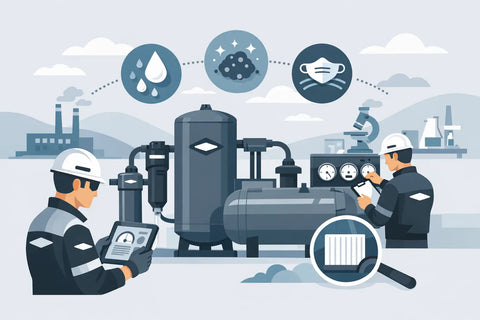
A compressor can be running perfectly and still cause production problems. The issue is often not pressure or flow. It is air quality. This compressed air quality standards guide is built for plant managers, maintenance teams, and operations leaders who need to match compressed air quality to real process risk, not guesswork.
When air quality is underspecified, you pay for contamination with scrap, product recalls, instrument failure, wet lines, and avoidable maintenance. When it is overspecified, you pay for treatment equipment, pressure drop, energy use, and filter replacements you may not need. The standard that helps you find the right balance is ISO 8573.
What compressed air quality standards actually measure
Compressed air is rarely just air. By the time ambient air is pulled into a compressor, compressed, cooled, stored, and distributed through piping, it can carry solid particles, water in liquid and vapor form, oil aerosol, oil vapor, and whatever the system itself sheds over time. Rust, pipe scale, compressor lubricant, condensate, and microbial growth can all become part of the problem.
That is why compressed air quality standards focus on contamination classes rather than broad labels like clean or dry. The most widely referenced framework is ISO 8573, especially ISO 8573-1, which defines quality classes for three main contaminants: particles, water, and oil.
For most industrial buyers, this matters because different applications fail in different ways. A CNC tool may tolerate one level of contamination. A food packaging line, paint booth, instrument air header, or medical process likely will not. Good air quality planning starts with the point of use, not the compressor room.
The ISO 8573 framework in a compressed air quality standards guide
ISO 8573-1 expresses air quality with three numbers, usually written in sequence for particles, water, and oil. A specification such as ISO 8573-1 Class 2.4.2 means the system is expected to meet Class 2 for particles, Class 4 for water, and Class 2 for oil.
The lower the class number, the cleaner the air. That sounds simple, but the trade-off is cost. Lower classes usually require more treatment stages, tighter monitoring, and closer maintenance control.
Particles
Particle classes address the size and concentration of solid contamination. This includes dust from intake air, wear debris from the compressor, and contamination from piping. Particle control typically relies on inlet filtration, coalescing filters, particulate filters, and clean distribution piping.
The required class depends heavily on what uses the air. General shop air may allow a higher particle class than instrumentation, spray finishing, or electronics manufacturing. If valves are sticking, seals are wearing early, or finished surfaces show defects, particle contamination is worth a closer look.
Water
Water is often the most visible compressed air quality problem. It can appear as liquid condensate in the receiver, moisture in branch lines, corroded piping, or process disruption at the end use. In ISO 8573, water classes are generally tied to pressure dew point.
Pressure dew point tells you the temperature at which moisture will condense under system pressure. The lower the dew point, the drier the air. Refrigerated dryers are common for general industrial use, but they are not the right answer for every application. If air lines run through hot days and cool nights, outdoor pipe racks, or conditioned spaces with temperature swings, dew point margins matter. Desiccant dryers are often needed where freezing conditions, critical instrumentation, or highly moisture-sensitive processes are involved.
Oil
Oil contamination includes liquid oil, aerosols, and vapor. Even in oil-free compressor systems, oil can enter from ambient air, nearby processes, or downstream equipment. In lubricated compressor systems, oil carryover becomes a larger design and maintenance issue.
Oil control usually requires a combination of separator performance at the compressor, coalescing filtration, activated carbon where necessary, and routine maintenance. If your process includes paint, food contact packaging, pharmaceuticals, breathing air, or sensitive pneumatic controls, oil class selection should be deliberate and documented.
How to choose the right air quality class
The biggest mistake is specifying one plant-wide air quality target for everything. Most facilities have mixed demand. Assembly tools, packaging equipment, air knives, instruments, pneumatic actuators, and process-contact applications do not all need the same air.
Start at the most sensitive use point and work backward. Ask what contamination can do in that application. Does moisture cause reject product? Does oil affect coating adhesion? Do particles damage valves or contaminate packaged goods? What is the cost of one hour of downtime or one bad production run? Those answers should drive the target class.
In some plants, the best solution is not treating every cubic foot of air to the highest standard. It is more efficient to treat the full system to a practical base level, then add point-of-use treatment where the process is critical. That approach can reduce capital cost and pressure drop while still protecting sensitive equipment.
Why the standard alone is not enough
A compressed air quality standard gives you a target. It does not guarantee the system will hit that target in real operating conditions. Actual performance depends on equipment selection, system layout, maintenance discipline, and load profile.
Dryers need proper flow sizing. Filters need the right micron rating, oil removal performance, and differential pressure management. Condensate drains need to work consistently. Piping needs to avoid dead legs, low spots, and corrosion-prone materials in the wrong environment. Receivers need to be placed and sized with system stability in mind.
This is where plants often get burned. A design may look acceptable on paper but fail under summer humidity, variable demand, compressor cycling, or neglected filter changes. Air quality should be treated like a system responsibility, not a single equipment purchase.
Common mismatch problems in the field
Many contamination issues show up as symptoms long before someone tests the air. Wet air can cause rust in drops, milky lubricant, sticky valves, and recurring drain problems. Oil carryover may appear as surface defects, filter saturation, or residue at the point of use. Particle issues may show up as instrument drift, regulator failure, or unusual wear in pneumatic tools.
Another common issue is assuming a dryer solves everything. A dryer manages moisture, but it does not remove all particles or oil. Likewise, a high-performance filter train will not compensate for an undersized dryer or damaged separator. Treatment stages have to work together.
There is also a cost side to overcorrecting. Chasing ultra-clean air where it is not required can add pressure drop, increase compressor run time, and raise energy costs. In a plant with tight production margins, that becomes a hidden operating expense month after month.
Testing, verification, and maintenance
If air quality matters to the process, verification should not be optional. That does not always mean constant monitoring at every branch, but it does mean testing the parameters that matter most to your risk profile.
For some facilities, periodic dew point measurement and filter inspection are enough. For others, especially where product quality or compliance is on the line, formal testing for particles, oil, and moisture at the point of use makes more sense. The key is to test where the air is actually consumed, not just at the compressor discharge.
Maintenance is what keeps the specified class achievable. Filters load over time and create pressure drop. Drains fail. Dryers drift out of spec. Separators wear. If preventive service is inconsistent, your air quality class becomes a guess.
That is why many operations prefer a planned service approach over reactive calls. With certified technicians, documented service intervals, and performance checks tied to the treatment equipment in place, it is much easier to protect both uptime and air quality.
When to review your compressed air quality standards guide assumptions
Air quality requirements should be reviewed whenever the process changes. New packaging materials, tighter QA standards, added instrumentation, production expansion, or a move into a more regulated market can all change what your system needs to deliver.
It is also worth reviewing after persistent failures, unexplained scrap, repeated filter issues, or major compressor room upgrades. A new compressor, dryer, or piping loop can improve reliability, but only if the whole system is aligned to the actual application.
For facilities in Southern California and Arizona, climate can also affect decisions around dryer selection, condensate management, and seasonal operating assumptions. Hot ambient conditions and wide temperature swings can expose weak points in treatment design faster than expected.
The right standard is the one your operation can consistently achieve without overspending to solve a problem you do not have. If there is uncertainty, start with the process risk, verify the current air quality, and size treatment around the real demand profile. Clean air is not about buying the most equipment. It is about protecting production with the right equipment, in the right order, maintained the right way.
