
A compressed air leak rarely announces itself with a dramatic failure. More often, it shows up as a compressor that runs longer than it should, pressure complaints at the far end of the plant, or energy costs that keep climbing without a clear production increase. That is exactly why a compressed air leak detection guide matters. Leaks are one of the most common and expensive sources of waste in industrial air systems, and they often stay in place for months because the system is still operating - just inefficiently.
For facilities where uptime matters, leak detection is not a side task. It is a maintenance priority tied directly to operating cost, equipment life, and production stability. A small leak at a fitting or quick-connect can seem harmless on its own, but dozens of small leaks across headers, drops, hoses, valves, and point-of-use devices add up fast. The result is avoidable load on compressors, dryers, filters, and drains, along with unnecessary wear on the entire system.
Why compressed air leaks cost more than most teams expect
Compressed air is one of the most expensive utilities in a plant because you are paying to create, treat, move, and control it. When air escapes through a leak, the loss is not just the compressed volume. You are also spending money on the electricity required to produce that air and on the maintenance required to support the extra runtime.
There is also a reliability angle. As leakage increases, compressors may cycle more frequently or stay loaded longer to maintain pressure. That can shorten service intervals and increase the chance of nuisance shutdowns. In some systems, operators respond to leaks by raising pressure setpoints. That may mask the symptom, but it usually increases power consumption and can create new issues downstream.
For plants with multiple shifts or critical processes, the cost of leaks extends beyond the utility bill. Unstable pressure can affect tools, packaging lines, valves, instrumentation, and production consistency. In those environments, leak detection is not just about efficiency. It is about protecting process performance.
Compressed air leak detection guide: where leaks usually happen
Most leaks occur at predictable points. Threaded fittings, unions, couplings, hose connections, filter housings, drain valves, pressure regulators, solenoids, and flexible lines are common sources. Aging seals and vibration make these areas especially vulnerable.
Improper installation is another factor. If piping is strained, poorly supported, or mismatched to the application, leaks tend to develop earlier. The same applies to neglected condensate management. Moisture can accelerate corrosion and damage components, particularly in systems without proper treatment.
It also depends on the age and layout of the system. A newer installation with engineered piping may have fewer leak points than an older facility that has expanded in phases over the years. Every added branch line, temporary hose, or legacy connection creates another opportunity for loss.
How to detect leaks without wasting maintenance time
The right detection method depends on how serious the leakage problem appears to be and how the system is used. For obvious leaks, a basic walk-through during non-production hours can uncover low-hanging fruit. Maintenance staff may hear hissing around regulators, quick-connects, and machine drops when ambient noise is lower.
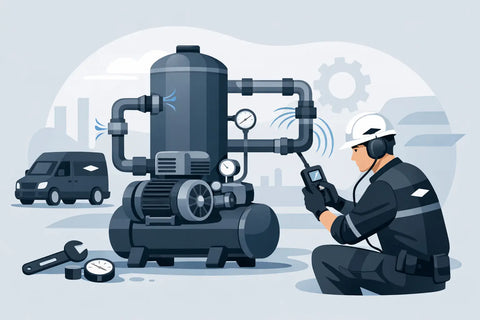
That said, listening alone has limits. In active industrial environments, production noise can hide smaller leaks, and some leaks occur in elevated, enclosed, or hard-to-access areas. That is where ultrasonic leak detection becomes more effective. Ultrasonic tools identify the high-frequency sound generated by escaping compressed air, allowing technicians to locate leaks with far more precision than the human ear.
A good inspection also includes system context. Pressure trends, compressor load patterns, and overnight run behavior can point to leakage even before individual leaks are identified. If demand looks unusually high during idle periods, that is often a warning sign that the system is feeding waste rather than production.
Using ultrasonic tools in a compressed air leak detection guide
Ultrasonic leak detection is often the most efficient approach for facilities that want measurable results. It helps technicians find leaks while equipment is operating, which means less disruption to production. The tool can isolate leak sources in noisy environments and support more accurate repair planning.
This matters in larger plants, where leaks may be spread across multiple buildings, utility corridors, mezzanines, and process areas. Instead of relying on guesswork, maintenance teams can document exact leak locations, assign repair priority, and verify that repairs were completed successfully.
The trade-off is that a tool is only as effective as the inspection process behind it. A rushed survey may catch the loudest leaks and miss the cumulative effect of smaller ones. A disciplined approach works better: inspect the compressor room, main distribution piping, branch lines, end-use equipment, and specialty devices in a logical sequence, then track findings in a way that supports follow-up.
What to prioritize first when leaks are found
Not every leak should be treated the same way. The largest leaks deserve immediate attention because they have the biggest direct cost. But repair priority should also consider accessibility, safety, and production impact.
For example, a moderate leak at a regulator serving a critical machine may deserve faster action than a larger leak in an isolated area that can wait for a scheduled shutdown. Some leaks are simple fixes, such as replacing a failed fitting or hose. Others point to broader issues like vibration, poor pipe support, contaminated air, or component wear that will keep causing repeat failures unless the root problem is addressed.
This is where experienced service support adds value. Repairing the visible leak is necessary. Understanding why it happened is what prevents the next round of waste.
Why leak repair should be tied to system performance
Leak detection works best when it is part of a broader compressed air strategy. If a facility only reacts when someone hears air escaping, the same problems usually come back. A better approach is to tie leak management to preventative maintenance, system audits, and operating benchmarks.
Start by establishing a baseline. Know how your compressors behave during production and during idle hours. Track pressure consistency, runtime, and service history. Once leaks are repaired, compare the data. Did loaded hours drop? Did pressure stability improve? Did operators stop reporting tool or equipment performance issues?
This kind of follow-through turns leak detection from a maintenance task into an operating improvement. It also gives procurement and operations leaders a clearer picture of return on maintenance spending.
Common mistakes that keep leaks coming back
One of the biggest mistakes is treating leaks as isolated events. If the same area keeps failing, there is usually a reason. Vibration, excess pressure, poor-quality fittings, inadequate filtration, or moisture carryover can all lead to recurring leaks.
Another mistake is delaying repairs because the system still appears functional. Plants often tolerate leakage until energy costs or pressure problems become hard to ignore. By that point, the waste has already compounded across compressor runtime, service costs, and lost efficiency.
There is also a staffing reality to consider. Many maintenance teams are stretched thin, and compressed air may not get the attention it deserves unless a failure forces action. In those cases, scheduled leak surveys and outside technical support can close the gap before reliability suffers.
When professional leak detection makes sense
Professional leak detection is usually the right move when a facility has rising energy use, pressure instability, multiple compressors running harder than expected, or a system that has grown complex over time. It also makes sense when in-house teams need help documenting leaks, prioritizing repairs, and validating savings.
For operations in Southern California and Arizona, where production schedules are tight and utility costs matter, a structured leak survey can pay off quickly. Certified technicians can identify hidden losses, evaluate related system issues, and help turn findings into a repair plan that fits production realities.
In many cases, the real value is not just finding leaks. It is connecting leak data to system design, maintenance planning, and long-term performance. That is the difference between fixing symptoms and improving the system.
Compressed air waste has a way of blending into the background until costs, downtime, or pressure issues force attention. The better move is to get ahead of it. A disciplined leak detection process gives you a clearer picture of system health, a stronger handle on operating costs, and fewer surprises when production depends on reliable air.
