
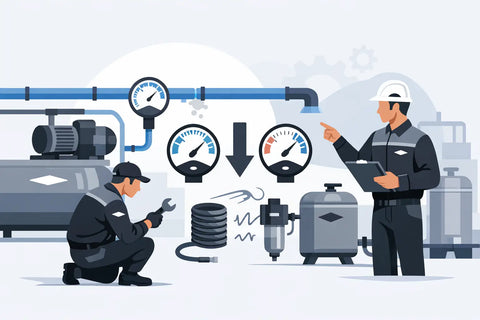
When a production line starts starving for air at the far end of the plant, the compressor is often the first thing blamed. In many cases, the real issue is somewhere between the compressor discharge and the point of use. Understanding compressed air pressure drop causes is the fastest way to stop low-pressure complaints, reduce wasted energy, and protect uptime.
Pressure drop is simply the loss of pressure as compressed air moves through the system. Some pressure loss is expected. The problem starts when that loss becomes excessive and operators compensate by raising compressor discharge pressure. That fix usually works for the moment, but it also drives up energy cost and can hide a bigger system problem.
Why pressure drop matters more than most plants think
A few PSI may not sound like much, but it affects the whole system. End-use equipment may cycle poorly, valves may respond slowly, tools may lose torque, and production quality can become inconsistent. At the same time, every extra PSI you ask the compressor to make increases operating cost.
This is why pressure drop should be treated as a system issue, not just a component issue. You may have a healthy compressor and still have poor performance if the dryer is undersized, the filters are loaded, the piping is restrictive, or demand spikes are not being managed correctly.
The most common compressed air pressure drop causes
Undersized or poorly designed piping
One of the most common compressed air pressure drop causes is piping that is simply too small for the required flow. Compressed air needs enough pipe diameter to move at a reasonable velocity. When the pipe is undersized, velocity rises and friction loss increases quickly.
This often shows up in plant expansions. A system that worked for one shift or one production line may start struggling after new equipment is added. Instead of redesigning the header, facilities sometimes keep extending branch lines from the original piping. The result is predictable - higher pressure drop, unstable pressure at peak demand, and more load on the compressor room.
Layout matters too. Long pipe runs, too many elbows, unnecessary tees, flexible hose used where rigid piping should be installed, and dead-end routing all add resistance. Even if the compressor has enough capacity, bad distribution design can keep that air from reaching the process efficiently.
Dirty or overloaded filters
Filters protect downstream equipment, but they create pressure drop as part of normal operation. As filter elements load with contaminants, differential pressure rises. If filters are not changed on schedule, they become a bottleneck.
This issue is common because filters are easy to ignore until someone notices a performance problem. In reality, a clogged prefilter or coalescing filter can quietly waste energy for months. The trade-off is straightforward - you need filtration for air quality and equipment protection, but you also need maintenance discipline to keep pressure loss under control.
Dryers that are undersized, fouled, or poorly maintained
Air dryers are another frequent source of pressure loss. Refrigerated dryers, desiccant dryers, drains, heat exchangers, and internal flow paths all need to operate correctly. If the dryer is undersized for actual flow, contaminated internally, or neglected, pressure drop increases.
This problem gets worse when system demand has grown beyond the original design basis. A dryer selected for a smaller load may still be online years later, even though the plant now consumes much more air. The dryer may still remove moisture, but it can create a pressure penalty that affects the whole facility.
Leaks and hidden demand
Leaks do not always show up as pressure drop in one obvious location, but they absolutely contribute to low pressure conditions. When leaks increase total demand, the system has to move more air through the same piping, treatment equipment, and storage. That extra flow increases pressure loss across the network.
Hidden demand works the same way. Open blowing, inappropriate uses of compressed air, failed solenoids, or machine settings that consume more air than expected can push the system beyond what it was designed to handle. Operators may only notice the symptom - low pressure at the point of use - without seeing the demand problem behind it.
Inadequate receiver storage
Storage helps stabilize pressure during short bursts of high demand. Without enough receiver capacity, temporary surges can create noticeable pressure dips even if the average compressor capacity looks acceptable on paper.
This is one of those it-depends issues. A plant with steady demand may run fine with modest storage, while a facility with intermittent high-flow equipment may need much more. If pressure complaints happen during specific machine cycles, shift changes, or batch events, storage should be part of the investigation.
Pressure regulators set incorrectly or failing
Point-of-use regulators are meant to control pressure for individual processes, but they can also become a source of restriction. A regulator set too low, installed incorrectly, or failing internally can create what looks like a broader system problem.
This is why pressure drop troubleshooting should not stop at the compressor room. Sometimes the issue is highly localized. One machine may be starved because of a bad regulator, kinked hose, or quick-connect fitting with limited flow capacity, while the rest of the plant is running normally.
Poor maintenance on separators, drains, and accessories
Moisture separators, automatic drains, aftercoolers, and other accessories can also contribute to pressure loss when they are dirty, blocked, or malfunctioning. A drain that fails closed can let condensate accumulate where it should not. Internal fouling or neglected service points create restrictions that add up over time.
Individually, these losses may seem minor. Across a full compressed air system, they become significant.
How to tell where the pressure is being lost
The key is to compare pressure readings at several points, not just at the compressor discharge. If pressure is healthy at the compressor but poor at the point of use, the problem is in storage, treatment, distribution, or local machine components.
Start by measuring pressure before and after major components such as filters, dryers, and regulators. Then compare readings at the compressor room header, at remote drops, and during both normal and peak production periods. Pressure data taken only during off-hours can be misleading because many systems look fine until demand rises.
It also helps to review whether the issue is constant or event-driven. A constant pressure loss often points to restrictions like fouled filters or undersized piping. A pressure dip tied to certain cycles or shifts may suggest inadequate storage, sudden demand spikes, or compressor control issues.
What plants often get wrong
A common mistake is solving low pressure by increasing the compressor setpoint without identifying the root cause. That may restore pressure at the end use, but it usually raises energy consumption and can stress the system unnecessarily.
Another mistake is replacing the compressor before evaluating the distribution system. More capacity does not fix bad piping, neglected filters, or a restrictive dryer. In fact, adding a larger compressor to a poor system can leave the original problem untouched while increasing capital and operating costs.
The better approach is to evaluate supply, treatment, storage, controls, and distribution as one system. That is where experienced service teams and certified technicians add real value. The goal is not just more air. It is stable pressure where the process needs it, with the lowest practical operating cost.
Reducing pressure drop without overbuilding the system
The right fix depends on the source of loss. In some plants, a filter change and leak repair program will make an immediate difference. In others, the system needs larger headers, a better looped piping layout, additional storage, or properly sized treatment equipment.
There are trade-offs. Oversizing every component is not good engineering, but neither is running a critical plant with no margin. Systems should be sized for actual demand patterns, air quality requirements, future growth, and acceptable pressure variation. That is especially important in uptime-critical environments where a few PSI can affect production, product quality, or compliance.
For facilities in Southern California and Arizona, where operating costs and downtime exposure are both serious concerns, pressure drop should be treated as an operating efficiency issue, not just a maintenance nuisance. A well-designed compressed air system pays back through reliability, lower energy use, and fewer emergency service calls.
If your team keeps hearing the same complaint - the compressor is running, but the air is not where it needs to be - pressure drop is worth a closer look. The fix is often less about making more air and more about getting the air you already have to the right place, at the right pressure, every time.
