
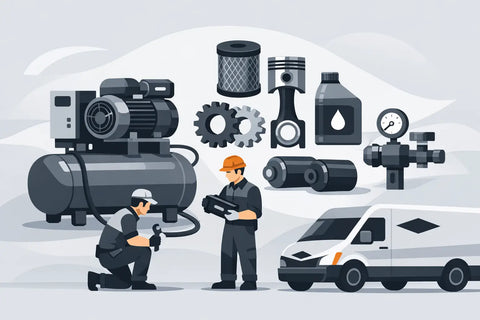
A compressor rarely fails all at once. More often, it starts with a pressure drop, rising discharge temperatures, oil carryover, moisture problems, or a motor working harder than it should. That is why air compressor replacement parts are not just maintenance items - they are part of your uptime strategy.
For plant managers and maintenance teams, the real question is not whether parts will wear out. It is whether those parts will be replaced at the right time, with the right fit, before a minor issue turns into lost production. In a facility where compressed air supports packaging lines, CNC equipment, automation, medical processes, or critical plant utilities, that timing matters.
Why air compressor replacement parts have a direct impact on uptime
Every compressed air system has consumable and wear components. Filters load up, separators lose efficiency, belts stretch, valves stick, and drains fail. When one part starts slipping out of spec, it affects the rest of the machine and often the entire air system.
A clogged intake filter, for example, does more than reduce airflow. It can raise operating temperature, increase energy use, and add strain to the airend. A failing oil separator does more than carry oil downstream. It can affect air quality, increase pressure differential, and create problems for dryers, filters, and end-use equipment. The part itself may be relatively inexpensive. The production impact usually is not.
This is where buyers often face a trade-off. It is tempting to treat replacement parts as a simple commodity purchase and focus on unit price alone. But the lowest-cost part is not always the lowest-cost outcome if it reduces service life, creates compatibility issues, or leads to a second shutdown.
The replacement parts that deserve the most attention
Some parts get replaced on a clear schedule. Others only get attention after performance drops. The most reliable maintenance programs do both - scheduled replacement for known wear items and condition-based response for parts that show signs of failure.
Filters and separators
Air intake filters, oil filters, inline compressed air filters, and oil separators are among the most common air compressor replacement parts. They also have an outsized effect on system performance.
When these components are neglected, compressors run hotter, pressure drop increases, contamination reaches downstream equipment, and energy costs creep upward. In oil-flooded rotary screw systems, separator performance is especially important because poor separation affects both machine health and air quality.
Belts, couplings, and drive components
Belt-driven compressors depend on correct tension and alignment. Over time, belts wear, glaze, crack, or stretch. Couplings can also degrade and introduce vibration or inefficient power transfer.
These parts may seem straightforward, but installation quality matters. A new belt installed with poor alignment can fail early and create avoidable downtime. It is one reason experienced technicians often catch secondary issues during a routine parts replacement.
Valves, drains, and regulators
Minimum pressure valves, inlet valves, check valves, solenoids, and condensate drains are all critical to stable operation. When they fail, symptoms can be misleading. A compressor may short cycle, fail to load properly, hold moisture in the system, or struggle to maintain target pressure.
Automatic drains deserve more attention than they usually get. A stuck drain can send condensate into lines and equipment. In a humid environment or a plant with strict air quality needs, that can lead to expensive downstream problems fast.
Gaskets, seals, and hoses
Small sealing components often get overlooked until there is a visible leak. By that point, the leak may already be affecting pressure stability, compressor run time, or housekeeping conditions around the machine.
Not every seal issue is urgent, but some are early warnings of heat, vibration, or pressure problems elsewhere in the package. Replacing the seal without addressing the root cause only resets the clock.
Choosing the right part is not always as simple as matching a model number
On paper, parts sourcing can look easy. Find the machine model, pull the part number, place the order. In practice, older equipment, field modifications, service history gaps, and cross-brand systems complicate that process.
That is especially true in facilities that have expanded over time and now run a mix of compressor brands, dryers, filters, and controls. A maintenance supervisor may be managing legacy equipment, newer variable speed units, rented backup equipment, and aftermarket components already installed by previous vendors. In that environment, accuracy matters.
OEM parts generally offer the clearest path for fit, performance, and warranty alignment. Aftermarket options can make sense in some cases, particularly for older equipment or budget-driven repairs, but quality varies. The right decision depends on the machine, the criticality of the application, and the operational cost of getting it wrong.
If a compressor supports a noncritical process with built-in redundancy, you may have more flexibility. If it feeds a production line where downtime costs thousands per hour, proven compatibility and service support usually matter more than saving a small amount on the part itself.
Signs you may need air compressor replacement parts sooner than expected
Scheduled maintenance intervals are the baseline, not the whole picture. Operating conditions can shorten part life significantly.
High ambient temperatures, dirty environments, long run hours, poor ventilation, frequent load changes, and incorrect service procedures all accelerate wear. A compressor in a clean, climate-controlled mechanical room will not age the same way as one sitting near dust, washdown exposure, or process heat.
Watch for warning signs such as rising differential pressure across filters or separators, increasing amperage draw, repeated high-temperature alarms, excessive condensate issues, unusual vibration, oil carryover, and pressure instability. None of these symptoms should be written off as normal aging. They usually point to a part problem, a system problem, or both.
A strong service partner does more than swap components. They help determine whether the failed part was the cause or the result.
Parts availability matters as much as parts quality
In an uptime-driven operation, the best replacement part is the one that is correct and available when you need it. Long lead times can turn a manageable repair into a production event.
That is why local inventory, multi-brand support, and field service coordination matter. If you are trying to source parts for a rotary screw compressor, dryer, drain, or filtration package under time pressure, it helps to work with a provider that understands the full system and can dispatch certified technicians if the repair goes beyond a simple swap.
For operations in Southern California and Arizona, that local responsiveness is not a nice extra. It can be the difference between a short maintenance window and a full day of disruption.
A better approach than one-off emergency orders
Emergency parts orders are sometimes unavoidable, but they should not be the default operating model. The most efficient facilities treat parts planning as part of asset management.
That usually means tracking service intervals, keeping critical spares on hand for high-impact equipment, and reviewing recurring failures to identify bigger issues. If the same valve, separator, or drain keeps failing early, there is likely a temperature, contamination, cycling, or installation problem behind it.
Preventive maintenance plans are useful here because they create structure. The goal is not replacing parts for the sake of replacing parts. The goal is replacing them before performance drops, energy costs rise, or reliability suffers. A good plan also helps procurement teams budget more accurately instead of reacting to unplanned failures.
This is where a full-service provider can add real value. Advanced Air & Vacuum supports customers with both parts access and certified service, which helps maintenance teams avoid the gap between buying a component and solving the underlying problem.
When to repair, rebuild, or replace the equipment
There are times when replacing parts is clearly the right move, and times when it is only delaying a larger decision. Age, run hours, efficiency loss, and repair frequency all factor in.
If a machine is otherwise sound and the issue is isolated to normal wear components, replacement parts are the cost-effective path. If the compressor has chronic failures, declining efficiency, control issues, or major airend or motor concerns, the math changes. Continuing to patch an aging unit can cost more than a planned replacement once you account for labor, energy, and unplanned downtime.
That decision should be based on operating data, not guesswork. A dependable service team can help assess whether a machine still fits the application or whether your facility has outgrown it.
The practical takeaway is simple. Air compressor replacement parts should never be treated as an afterthought. They affect reliability, energy use, air quality, and maintenance cost every day the system runs. When parts selection, availability, and service support are handled well, you get more than a repaired compressor. You get a system that stays ready for the next shift.
