
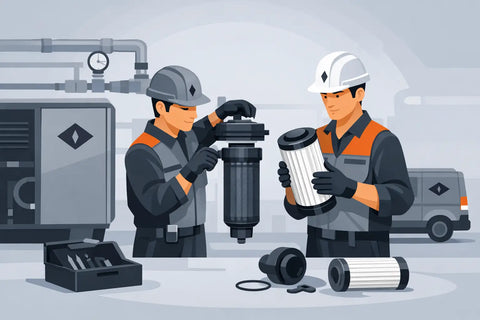
A compressed air system rarely fails all at once. More often, performance slips first. Pressure drop creeps up, drains struggle, downstream equipment sees more contamination, and energy costs rise without an obvious root cause. In many facilities, compressed air filter replacement is one of the simplest ways to correct those problems before they turn into production losses.
Filters do more than clean the air line. They protect dryers, valves, instruments, pneumatic tools, packaging equipment, and finished products from oil aerosols, water, rust, scale, and fine particulates. When a filter element reaches the end of its service life, it does not just become less effective. It can also create added restriction, forcing the compressor to work harder to maintain required pressure.
That trade-off matters to plant managers and maintenance teams because compressed air is usually tied directly to uptime. A neglected filter may look like a small maintenance item, but it can affect product quality, equipment life, and utility spend across the system.
Why compressed air filter replacement matters
Every compressed air filter is designed around a specific job. Some remove bulk liquid and larger particles. Others target fine particulates. Coalescing filters remove oil aerosols and very small contaminants, while vapor removal filters address oil odors and traces that can be unacceptable in sensitive applications.
As those elements load with contaminants, two things happen. First, filtration performance can decline depending on the filter type and operating conditions. Second, differential pressure increases. That extra pressure drop means the system needs more energy to deliver the same usable air pressure at the point of use.
The cost impact is often understated. A filter element is inexpensive compared with the cost of running a compressor at a higher pressure setpoint just to overcome restriction. Add the risk of moisture carryover, poor actuator performance, or contamination in process equipment, and replacement becomes a maintenance priority rather than a routine supply purchase.
For facilities with strict quality requirements, the stakes are even higher. Food and beverage, healthcare, electronics, defense, and precision manufacturing operations may need tighter air quality control than general plant air applications. In those environments, waiting too long on filter service can create quality escapes, compliance concerns, or preventable equipment failures.
Signs your compressed air filter replacement is overdue
The most reliable trigger is the manufacturer service interval combined with actual operating conditions. Still, in the field, there are practical signs that a filter element is past due.
A rising pressure drop across the filter is one of the clearest indicators. If differential pressure is increasing, the element is loading up. Water or oil appearing downstream is another warning sign, especially if the dryer and drains are functioning properly. You may also notice sluggish pneumatic equipment, reduced point-of-use pressure, more frequent compressor loading, or a need to increase system pressure to keep production running.
Visual inspection can help, but it is not enough on its own. Some filter elements look acceptable externally while performance has already degraded. That is why scheduled service based on hours, conditions, and air quality requirements usually produces better results than waiting for an obvious failure.
Environment matters too. A facility with high ambient dust, heavy compressor oil carryover, elevated temperatures, or frequent load swings may need more frequent replacement than a clean, stable operation. There is no one-size-fits-all interval that works for every plant.
How often should filters be replaced?
The short answer is that it depends on filter type, compressor condition, system demand, and the level of air purity required downstream. Many manufacturers recommend annual replacement for coalescing and particulate elements under normal operating conditions. In tougher applications, the interval may be shorter.
That said, calendar-based replacement only works if the system is otherwise healthy. If a compressor has excessive oil carryover, drains are malfunctioning, or an upstream separator is underperforming, filter elements can load much faster than expected. Replacing elements without correcting the root cause simply repeats the cycle.
A better approach is to combine three inputs: manufacturer recommendations, pressure drop monitoring, and actual system conditions. That gives maintenance teams a defensible schedule and helps avoid both under-servicing and premature replacement.
Choosing the right replacement filter
Not every element that fits the housing is the right element for the application. Micron rating, efficiency, flow capacity, pressure rating, temperature limits, and compatibility with the existing housing all matter. So does the sequence of filtration.
For example, installing a fine coalescing element without proper upstream bulk liquid removal can shorten service life and reduce efficiency. Likewise, using a lower-grade replacement to save on parts cost may increase downstream contamination or energy loss. The cheaper element is not always the lower-cost decision once performance and service life are considered.
OEM versus aftermarket is another area where the answer depends on the situation. High-quality aftermarket options can perform well when they are correctly matched, but not all replacements are built to the same standard. In critical systems, verified compatibility and performance data should carry more weight than unit price alone.
This is where experienced service support helps. A certified technician can look beyond the filter itself and confirm whether the current setup still matches the application, or whether the system needs a different filtration strategy because production demands have changed.
What gets missed during filter service
Compressed air filter replacement should not be treated as swapping one element for another and moving on. The housing, seals, drains, differential indicators, and surrounding piping condition all affect results.
A worn O-ring, cracked bowl, clogged automatic drain, or corroded housing can create leaks, bypass contamination, or safety issues. If condensate is not being removed correctly, even a new element may fail early. If pressure drop indicators are inaccurate or ignored, replacement intervals become guesswork.
It also makes sense to review what happened to the old filter. Was it loaded with particulates, saturated with oil, or damaged by moisture? Each failure pattern tells you something about upstream conditions. Good maintenance does not stop at replacement. It uses the replacement event to diagnose the system.
The cost of waiting too long
Most facilities do not delay filter changes because they do not care. They delay because the issue seems minor compared with production demands. The problem is that compressed air contamination and pressure drop tend to create hidden costs before they create visible breakdowns.
Those costs show up as higher energy consumption, shorter life for pneumatic components, added maintenance labor, poor process consistency, and unplanned interruptions. In some operations, they also show up as scrap, rejected product, or instrument problems that are difficult to trace back to air quality.
There is also the labor factor. Emergency service on a contamination-related issue usually costs more than scheduled maintenance, and it creates more disruption. A planned replacement during regular service windows is almost always the better operational decision.
Building compressed air filter replacement into preventive maintenance
The best filter programs are systematic. They track filter locations, element types, install dates, pressure drop trends, and replacement intervals. They also tie filter service to broader preventive maintenance tasks such as drain checks, dryer inspections, compressor service, and leak reviews.
That matters in larger facilities where compressed air treatment is spread across a compressor room and multiple point-of-use stations. Missing one critical filter can undermine the performance of the whole treatment chain.
For many operations, the practical answer is to standardize service through a maintenance plan. That reduces the risk of overlooked elements, mismatched parts, and reactive purchasing. It also gives procurement and operations teams a more predictable maintenance cost structure.
If your facility runs multiple compressor brands or a mix of legacy and newer equipment, having one service partner manage the filtration side can simplify things considerably. Advanced Air & Vacuum often sees this with plants that need both parts support and field service across different equipment types.
When replacement alone is not enough
Sometimes repeated filter issues are a symptom, not the problem. If elements are fouling too quickly, pressure drop returns early, or downstream contamination continues after service, the system may need a deeper review.
Possible causes include an undersized filter, poor drain performance, excessive compressor oil carryover, a failing dryer, incorrect filter placement, or demand that has outgrown the original design. In those cases, replacing the element is necessary, but it will not fully solve the issue.
A system assessment can reveal whether the problem is maintenance-related or design-related. That distinction matters because it changes the solution. The right fix may be as simple as adjusting service intervals, or it may involve upgrading treatment equipment to match current production needs.
Compressed air systems reward attention to the basics. Filter replacement is one of those basics, but it carries more impact than its size suggests. When the right filters are replaced at the right time, the payoff is straightforward - cleaner air, lower pressure drop, better equipment protection, and fewer surprises when production is on the line. If your system has been showing small warning signs, this is one maintenance item worth addressing before it turns into a larger operational problem.
