
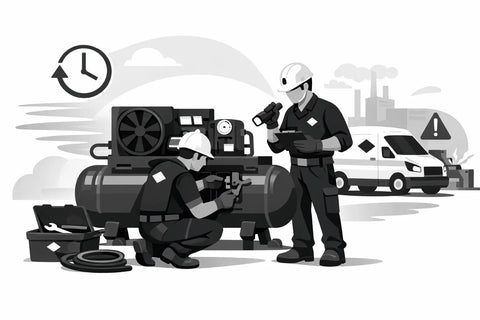
A compressor failure rarely happens at a convenient time. It shows up in the middle of a production run, during a shift change, or right when demand spikes and every minute of downtime starts turning into scrap, missed orders, or safety concerns. That is why emergency air compressor repair is not just a maintenance issue. It is an operations issue, and the speed and quality of the response matter just as much as the repair itself.
When compressed air supports packaging lines, CNC equipment, process controls, medical systems, or plant utilities, the right question is not just how to get the machine running again. The real question is how to restore reliable air without creating a second failure a few hours later.
What emergency air compressor repair really involves
In an industrial setting, emergency service is more than swapping a failed part and restarting the unit. A qualified response starts with isolating the problem, protecting downstream equipment, and confirming whether the compressor failure is the root cause or a symptom of a larger system issue.
A tripped compressor may point to a bad motor starter, but it may also trace back to overheated oil, a clogged separator, a failed pressure transducer, poor ventilation, or voltage imbalance. Low pressure at the plant header may look like compressor failure when the actual problem is a major leak, a saturated filter, or a dryer that is restricting flow. The fastest repair is not always the best repair if no one verifies what caused the shutdown.
That is why experienced technicians work in stages. First, they stabilize the situation. Then they diagnose the failure. After that, they determine whether a temporary recovery is acceptable or whether a full corrective repair is needed before the system should be put back under load.
The first hour matters most
The early response window usually determines whether the event stays contained or becomes a prolonged outage. Plant teams can make that first hour more productive if they focus on facts instead of trial-and-error resets.
Start by documenting alarms, pressure readings, oil temperature, unusual noise, vibration, and anything that changed before the shutdown. If another contractor was recently on site, if a filter was changed, or if power work was done in the area, that context helps. So does knowing whether the failure affected one compressor or the whole compressed air system.
It also helps to avoid the common mistake of repeatedly restarting a compressor that has already gone into protective shutdown. If the machine tripped on high temperature, low oil pressure, or motor overload, forcing another restart can turn a manageable repair into a larger failure. Bearings, motors, and airends are expensive places to learn that lesson.
What your team should check before service arrives
There are a few safe, practical checks that can speed up emergency air compressor repair. Verify incoming power, look for an obvious blown fuse or tripped breaker, confirm emergency stops are reset, and inspect for blocked coolers or ventilation problems. Check fluid level where applicable and look for visible leaks around hoses, drains, fittings, and separator components.
Just as important, determine whether backup capacity is available. If a secondary compressor can support critical loads, even at reduced production rates, you gain time to repair the failed unit properly instead of rushing a decision. In some facilities, isolating nonessential air use is enough to keep priority operations online while service is underway.
Why compressor emergencies are often system emergencies
One of the biggest mistakes in emergency response is treating the compressor as a standalone machine. In reality, compressed air reliability depends on the entire system - controls, storage, treatment, piping, drains, and demand behavior.
A compressor may fail because wet air damaged controls. A dryer issue may create pressure drop that forces the compressor to run hotter and longer. Undersized piping can push the machine into excessive cycling. A neglected condensate drain can send moisture where it should never go. If the service call ends with a new part but no system review, the same failure pattern can come back quickly.
This is where multi-brand service experience matters. Facilities often have mixed equipment from different manufacturers, installed over time, with controls and treatment components that do not always communicate cleanly. A technician who only looks at the nameplate on the failed compressor will miss what the rest of the system is doing.
Common causes behind emergency air compressor repair calls
Most urgent calls fall into a few categories, but the cause is not always as obvious as the symptom. Electrical failures are common, especially with overloaded starters, failed contactors, bad sensors, and utility power issues. Thermal shutdowns are another major category, often tied to dirty coolers, poor ventilation, fluid problems, or high ambient temperatures.
Air and oil leaks also drive emergency service, especially when they lead to pressure loss, contamination, or unsafe operating conditions. Control failures can be harder to spot because they may present as nuisance trips, erratic loading, or unexplained pressure swings. Then there are mechanical failures such as bearings, couplings, belts, and airend issues, where early warning signs were often present but easy to miss during busy production periods.
The trade-off during diagnosis is speed versus certainty. In some situations, a fast component replacement makes sense to restore production. In others, especially when damage may have spread, it is smarter to test further before putting the machine back into service. That decision should be based on risk, not optimism.
When a temporary fix makes sense and when it does not
Not every emergency repair should be treated as permanent on the first visit. Sometimes a temporary stabilization is the right operational move. If a facility can run safely on reduced load with a temporary part, rental equipment, or a rebalanced system while a full repair is scheduled, that can protect production without forcing a rushed capital decision.
But there are limits. A compressor with severe internal damage, recurring high-temperature shutdowns, contaminated oil, or evidence of electrical arcing should not be pushed back into full-duty operation just to get through another shift. The short-term gain can become a major rebuild, or worse, a total failure.
This is where a service partner should be direct. Plant teams need a clear explanation of what is confirmed, what is suspected, what can run safely, and what needs immediate correction. No guesswork, no vague language.
How to reduce repeat emergencies after the repair
The real cost of a compressor outage is not only the emergency call. It is the repeat call a month later because the underlying issue was never addressed. After the machine is back online, there should be a follow-up plan.
That usually means reviewing service history, checking system pressure trends, inspecting treatment equipment, and confirming that maintenance intervals align with actual operating conditions. A compressor in a hot, dusty production area will not behave like the same model in a clean utility room. Run hours, load profile, and environmental conditions change maintenance needs.
Facilities that depend heavily on compressed air should also look at redundancy. If one unit fails, can another carry critical loads? Is there enough storage? Are controls sequencing machines properly? Is demand being monitored, or is the plant just adding compressors whenever pressure drops? Emergency air compressor repair solves today’s outage, but resilience planning reduces the next one.
Choosing the right emergency air compressor repair partner
In an outage, response time matters. So do parts availability, technical depth, and the ability to support more than one brand. A provider should be able to troubleshoot compressors, dryers, filters, controls, and related system components as one integrated process, not as isolated products.
That is especially important for facilities in Southern California and Arizona, where high operating demand, heat, and production pressure can expose weak points in compressed air systems quickly. A service partner with certified technicians, stocked parts access, rental support, and field experience across industrial environments can shorten downtime and improve repair quality at the same time.
Advanced Air & Vacuum works with that full-system mindset because industrial customers do not need fragmented support during a shutdown. They need a team that can diagnose the failure, restore air, and help prevent the same event from interrupting production again.
The best emergency call is the one you avoid
No facility eliminates compressor risk completely. Equipment ages, conditions change, and failures still happen. But the plants that recover fastest usually have three things in place before the outage starts: current maintenance records, a clear service contact, and a compressed air system that has been evaluated beyond the compressor alone.
If your compressor room has become a place where alarms are normal, pressure swings are ignored, and small leaks keep getting pushed to next month, the next emergency is already developing. A prompt repair gets you moving again. A disciplined service strategy keeps you from fighting the same fire twice.
