
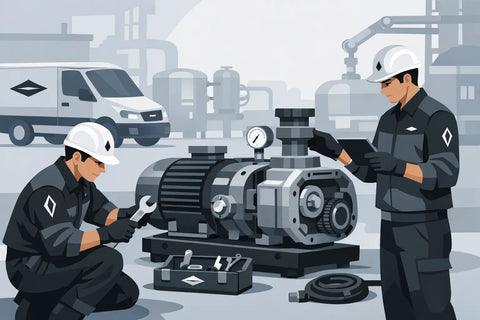
A vacuum pump rarely fails at a convenient time. More often, it starts with a slower cycle, weaker hold-down force, rising operating temperature, or a line operator reporting that performance just is not where it should be. Industrial vacuum pump repair matters most in that moment - when production, product quality, and maintenance budgets are all on the line.
For plant managers and maintenance teams, the real question is not just how to fix a pump. It is how to restore reliable performance without creating repeat failures a few weeks later. That takes more than swapping parts. It takes accurate diagnosis, experienced service, and a repair plan that fits the age, duty cycle, and role of the pump in your operation.
What industrial vacuum pump repair should actually solve
A proper repair should do more than get the unit turning again. It should address the root cause of the failure, verify system conditions, and give your team a clear picture of what comes next.
That distinction matters because many vacuum pump problems are symptoms, not standalone failures. A worn vane set may be real, but it may also be tied to contaminated oil, excessive heat, clogged filtration, process carryover, poor ventilation, or a mismatch between the pump and the application. If those factors are not corrected, the pump goes back into service with the same conditions that caused the original breakdown.
For operations leaders, that turns one repair invoice into two, plus lost production. Good service prevents that cycle.
Common signs you need industrial vacuum pump repair
Most pumps do not go from normal operation to complete shutdown without warning. The signs show up earlier, and catching them early usually means lower repair cost and less disruption.
Performance loss under load
If the pump reaches vacuum more slowly than before, struggles during peak demand, or cannot hold the required level consistently, internal wear or leakage may be developing. In some cases, the issue is inside the pump. In others, the pump is sound and the problem sits elsewhere in the system, such as piping leaks, blocked filters, or failing valves.
Heat, noise, and vibration
Rising temperature, unusual vibration, or a change in sound profile often points to mechanical wear. Bearings, couplings, misalignment, inadequate lubrication, and restricted cooling all deserve attention. These issues are easy to dismiss when the unit is still running, but they tend to become expensive if left alone.
Oil contamination or excessive oil use
For oil-lubricated pumps, dirty oil is never just a housekeeping problem. It can indicate process contamination, internal wear, moisture intrusion, or poor service intervals. Excessive oil consumption may point to sealing issues or wear that affects both pump efficiency and downstream product quality.
Repeated alarms or nuisance shutdowns
A pump that trips on temperature, pressure, overload, or control faults may be protecting itself from a larger problem. Resetting the alarm might restore operation temporarily, but repeated alarms are usually telling you that repair or deeper system troubleshooting is overdue.
Repair or replace? It depends on the full picture
This is where experience matters. Not every failing pump should be rebuilt, and not every old pump should be replaced.
If the pump is relatively modern, correctly sized, and structurally sound, repair is often the right move. Replacing bearings, seals, vanes, filters, gaskets, motors, or controls can return the unit to dependable service at a fraction of replacement cost. That is especially true when lead times for a new unit would create operational risk.
On the other hand, replacement may make more sense when failures are recurring, parts availability is poor, efficiency is unacceptable, or the pump no longer fits the process. A low-cost repair on an outdated machine can become a high-cost decision if it keeps draining labor, energy, and uptime.
The right answer usually comes down to five factors: the condition of the core assembly, repair cost versus replacement cost, the pump's role in production, lead time risk, and whether the system itself needs to be redesigned. A service partner should be candid about those trade-offs, not push one answer every time.
What a reliable repair process looks like
Industrial buyers do not need vague assurances. They need a process that moves quickly and reduces uncertainty.
A strong repair starts with inspection and diagnosis. That includes reviewing symptoms, operating history, maintenance records, and the actual application. Technicians should confirm whether the issue is mechanical, electrical, thermal, or system-related before recommending parts.
From there, disassembly and inspection should identify wear patterns and hidden damage. On vacuum pumps, one failed component often affects others. Replacing only the visibly broken part can leave secondary damage untouched.
After parts replacement and corrective work, testing matters just as much as the repair itself. Vacuum level, temperature, amperage, vibration, leak integrity, and control function all need to be verified before the pump returns to production. Without that final validation, the repair is incomplete.
Documentation also has real value. Maintenance supervisors should know what failed, what was replaced, what conditions may have contributed, and what preventive actions are recommended next. That information helps budgeting, planning, and future troubleshooting.
Why root-cause diagnosis saves more than the repair itself
The fastest fix is not always the lowest-cost fix. If a pump fails because of process contamination, poor filtration, incorrect rotation, cooling issues, or chronic overloading, repairing the pump alone only treats the symptom.
This is where industrial vacuum pump repair becomes part of a larger reliability strategy. The pump may need service, but the surrounding system may also need attention. Intake filtration may be undersized. Piping may have restrictions or leaks. The process may be introducing condensate or particulates the pump was never meant to handle. In some facilities, maintenance intervals are simply too long for the duty cycle.
Addressing those conditions can reduce emergency calls, extend equipment life, and stabilize production. It also helps procurement and operations teams plan spending instead of reacting to failures one at a time.
The cost of waiting too long
Many facilities delay repair because the pump is still running. That is understandable, especially when production schedules are tight. But the economics often shift quickly once the damage spreads.
A worn seal can become internal scoring. A lubrication problem can become bearing failure. A high-heat condition can damage adjacent components and shorten motor life. What could have been a planned service event becomes an after-hours emergency, with rush parts, production loss, and more disruption across the line.
There is also the quality risk. In packaging, medical, food, electronics, and process manufacturing environments, unstable vacuum can affect product consistency, handling, and yield before anyone sees a full shutdown. That hidden cost is easy to miss if the only metric being watched is whether the pump still turns on.
Preventive maintenance after industrial vacuum pump repair
The best repair programs do not stop when the unit is back online. They use the repair as a checkpoint to tighten maintenance practices.
Service intervals should match the application
A pump operating in a clean, controlled setting does not age the same way as one exposed to dust, moisture, vapors, or heavy cycling. Generic intervals are a starting point, not a strategy. Maintenance frequency should reflect actual operating conditions.
Consumables and wear parts need attention
Filters, oil, seals, vanes, belts, and related service items have a direct effect on pump performance. Delaying routine replacement often creates larger failures downstream. Stocking critical parts can also shorten recovery time when service is needed.
Trend data helps catch changes early
Temperature, amperage, vacuum level, vibration, and service history can reveal a pump that is drifting out of spec before failure occurs. Facilities that track these indicators usually make better repair decisions and avoid more emergencies.
For many plants, working with a service provider that supports both emergency response and scheduled maintenance is the most practical model. It keeps responsibility clear and gives your team a single source for diagnosis, repair, parts, and long-term support.
Choosing the right repair partner
Not every service company is built for uptime-critical industrial equipment. When evaluating support for vacuum systems, look for certified technicians, multi-brand repair capability, access to replacement parts, and the ability to diagnose the full system rather than just the pump.
Response time matters too, especially for facilities in Southern California and Arizona where production schedules can leave very little room for equipment delays. The provider should be able to support both urgent breakdowns and planned maintenance, because most plants need both at different times.
Just as important, the service team should communicate clearly. You should know what failed, what it will take to correct it, whether repair is truly the best option, and what steps will reduce the chance of seeing the same problem again. That is the standard Advanced Air & Vacuum is built to support.
When a vacuum pump starts slipping, waiting for total failure rarely saves money. The smarter move is to treat early symptoms as a chance to restore performance on your terms, before downtime makes the decision for you.
