
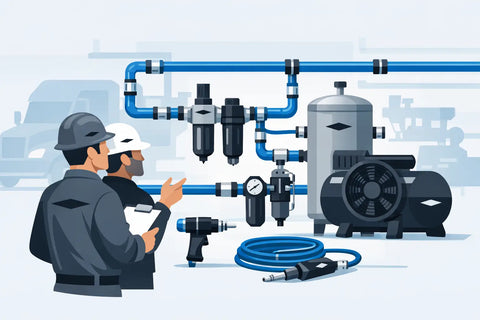
A compressed air system can have a premium compressor, quality dryers, and proper filtration, then still underperform because the piping is wrong. That is why Prevost compressed air piping gets so much attention from plant managers and maintenance teams who are tired of chasing pressure drop, leaks, and expansion headaches.
Piping is not a background component. It affects usable pressure at the point of use, installation time, future flexibility, and the long-term cost of ownership. When a facility is planning a new system or correcting an older one, the piping choice has a direct impact on uptime.
Why Prevost compressed air piping stands out
Prevost compressed air piping is designed as a modular aluminum system for compressed air distribution. In practical terms, that means a lighter, cleaner, and more adaptable alternative to traditional black iron in many facilities. The system is built around aluminum pipe and mechanical fittings that support quicker installation and easier system changes over time.
For operations teams, the biggest advantage is usually not one feature by itself. It is the combined effect of lower friction loss, corrosion resistance, and faster installation. Those three factors can improve system performance right away while also reducing labor during both the initial build and later modifications.
Aluminum piping has a smoother internal surface than older metal piping options that tend to degrade internally. That smoother bore helps maintain flow and reduce pressure losses across the distribution network. If your compressor room is already operating near its limits, every avoided PSI of drop matters.
Corrosion resistance is another major factor. Black iron can rust internally, and that contamination does not stay in the pipe. It travels downstream, loading filters, affecting tools, and creating extra maintenance work. In facilities where air quality and clean operation matter, that is a real cost, not a theoretical one.
Performance gains are usually about the whole system
A piping upgrade does not fix every compressed air problem. If the compressor is undersized, the dryer is failing, or point-of-use demand is poorly managed, a new piping system will not erase those issues. Still, piping often plays a larger role than people expect.
A well-designed Prevost compressed air piping layout can support more stable pressure throughout the plant, especially during peak demand. That can help tools run more consistently, reduce the temptation to raise system pressure, and improve energy efficiency. Raising compressor discharge pressure just to overcome bad distribution is expensive. Fixing the distribution is usually the better move.
Layout matters as much as material. A looped system, properly sized headers, well-placed drops, and effective drainage strategy will outperform a poorly planned installation no matter which brand is used. The right product still needs the right engineering behind it.
Where facilities usually see the benefit
In most industrial settings, the benefit shows up in four places - fewer leaks, cleaner air delivery, simpler future expansion, and reduced installation disruption. That last point matters more than many project teams admit. If you can install or modify piping with less downtime and less labor, the payback calculation changes.
This is especially relevant in active plants where shutdown windows are short. A modular aluminum system can often be installed faster and with less impact on operations than more labor-intensive alternatives.
Installation advantages and trade-offs
Prevost compressed air piping is often chosen because it is easier to handle and faster to assemble than heavier traditional piping. That can reduce installation labor and help contractors or in-house teams complete projects with less disruption. It also tends to make future branch additions more straightforward.
That said, trade-offs do exist. Material cost can be higher upfront compared with some conventional pipe options. For buyers focused only on initial purchase price, that can create hesitation. But compressed air infrastructure should be judged on lifecycle cost, not just invoice cost. Labor, leak reduction, serviceability, and energy performance all belong in the decision.
Environment also matters. Piping selection should account for temperature, pressure requirements, chemical exposure, mounting conditions, and the nature of the facility. A food plant, machine shop, hospital support system, and municipal site may all have different constraints. The right answer depends on the application.
Expansion is where modular piping often proves its value
Most plants do not stay static. Production lines shift, work cells get added, and utility demand changes. A piping system that is painful to modify becomes a hidden operational problem. This is one reason modular systems continue gaining traction.
With Prevost compressed air piping, future takeoffs and reroutes are generally easier to plan and execute. That matters for facilities that expect growth or periodic reconfiguration. It also matters for maintenance teams who need a system they can work with, not around.
Common mistakes when specifying compressed air piping
The biggest mistake is treating piping as a commodity. It is easy to compare only diameter and price, then miss how the system performs over time. Pressure drop, leak risk, installation quality, support spacing, condensate management, and accessibility all affect results.
Another common issue is undersizing the main header. A system may look acceptable on paper, then struggle during production peaks because the demand profile was not properly considered. Buying good piping does not compensate for poor sizing.
Drainage strategy is also frequently overlooked. Compressed air systems generate condensate, and piping should be laid out to help control and remove it. Poorly designed drops or flat runs can send water where it does not belong, leading to corrosion in some systems, tool damage, or process trouble downstream.
Support and alignment matter too. Even quality piping can become a problem if it is poorly installed, overstrained, or fitted without regard for service access. This is where experienced installation crews make a difference.
Is Prevost compressed air piping right for every facility?
Not automatically. It is a strong fit for many industrial and commercial compressed air systems, particularly where clean distribution, ease of expansion, and reduced installation time are priorities. It is often a practical choice for manufacturing plants, healthcare support applications, packaging operations, automotive facilities, and other sites where uptime matters.
But every system should be evaluated against actual operating conditions. Pressure, flow, future demand, building layout, and shutdown limitations all shape the recommendation. In some cases, the best path is a full piping replacement. In others, a phased retrofit makes more sense.
That is why site evaluation is worth the time. An experienced compressed air partner can review the existing distribution network, identify restrictions or leak-prone areas, and determine whether Prevost compressed air piping makes sense as a complete solution or as part of a broader system upgrade.
What to look for before you move forward
If you are considering a piping upgrade, start with the operating problems you are trying to solve. That might be pressure loss at the far end of the plant, repeated leaks, contamination concerns, or a planned expansion that the current layout cannot support. The right design starts with those realities, not with a generic product preference.
From there, evaluate the full system. Look at compressor capacity, dryer performance, filtration, storage, controls, and the distribution layout together. Piping works best when it is part of a coordinated approach to compressed air reliability.
Installation support is also part of the decision. A well-engineered product still depends on proper routing, secure mounting, clean assembly, and startup verification. For many facilities, the value comes from working with a provider that can handle design, supply, installation, and ongoing service under one roof. That shortens project timelines and reduces finger-pointing if issues come up later.
In regions with demanding production schedules, heat, and limited maintenance windows, that level of support can be the difference between a clean upgrade and a project that drags on. Advanced Air & Vacuum works with facilities that need practical answers, not guesswork, and piping projects are no exception.
A compressed air system should make production easier, not create another maintenance problem. If your current distribution network is costing pressure, time, or reliability, it may be time to look harder at the piping than the compressor.
