
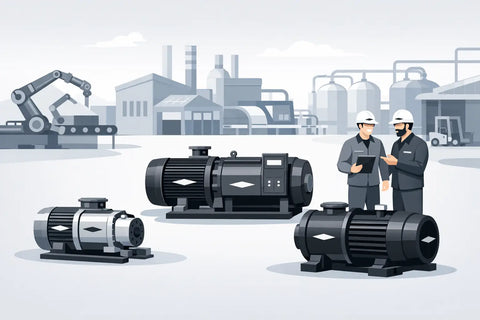
A vacuum pump that looks right on a specification sheet can still become a production problem. If it cannot handle moisture, product carryover, heat, or continuous-duty demand, maintenance intervals shrink and line performance suffers. The best vacuum pumps for manufacturing are not defined by one technology or one brand. They are the pumps that consistently deliver the required vacuum and flow under the actual conditions on your plant floor.
For plant managers and maintenance teams, the decision should begin with the process, not the catalog. Required vacuum level matters, but so do evacuation time, contaminant load, operating hours, utility costs, available service support, and the consequences of an unplanned shutdown. A properly selected system protects throughput. A poorly matched pump creates waste, quality issues, and avoidable downtime.
What Makes a Vacuum Pump Right for Manufacturing?
Manufacturing applications use vacuum in very different ways. Thermoforming requires fast air removal and repeatable cycle times. Packaging operations may need clean, reliable vacuum near food or consumer products. CNC workholding needs stable holding force. Medical, electronics, and aerospace processes can demand deeper vacuum levels and tighter contamination control.
That means the right pump must be sized for both pressure and pumping speed. Vacuum level is typically expressed as absolute pressure, while pumping speed is often measured in cubic feet per minute or cubic meters per hour. A pump can achieve a deep ultimate vacuum but still be the wrong choice if it takes too long to evacuate the process volume. Conversely, a high-flow pump may move plenty of air yet fail to reach the pressure required for the process.
A practical evaluation also accounts for the real gas load. Leaks, porous fixtures, moisture, vapor, and material off-gassing all add load that may not appear in an initial calculation. In facilities with long vacuum piping runs or multiple points of use, pressure losses and simultaneous demand can change the final equipment requirement significantly.
Best Vacuum Pumps for Manufacturing by Application
Oil-sealed rotary vane pumps
Oil-sealed rotary vane pumps remain a common choice for general industrial vacuum because they provide dependable performance, relatively deep vacuum capability, and a compact footprint. They are well suited to packaging, forming, pick-and-place systems, laboratory support, degassing, and many workholding applications.
Their trade-off is oil management. The oil seals, lubricates, and helps remove heat, so condition monitoring and scheduled oil changes are essential. Process vapors and moisture can contaminate the lubricant, reducing performance and shortening service life. In wet or dirty applications, inlet filtration, condensate management, and properly sized traps are not optional accessories. They are part of the system design.
Dry claw vacuum pumps
Dry claw pumps are often an excellent fit when manufacturers want to reduce oil-related maintenance and avoid process contamination. Their non-contacting claw design operates without oil in the compression chamber, making them useful for applications involving moisture, dust, packaging environments, wood processing, pneumatic conveying, and central vacuum systems.
They typically offer strong efficiency in continuous industrial service and can tolerate a wider range of process conditions than some oil-lubricated designs. However, dry does not mean maintenance-free. Filters, cooling systems, seals, and clearances still require inspection. Fine abrasive material or excessive heat can create problems if the pump is not protected and maintained correctly.
Dry screw vacuum pumps
Dry screw pumps are built for demanding processes that require clean operation, deep vacuum performance, and the ability to handle challenging gas streams. They are frequently considered for chemical processing, pharmaceutical production, electronics, heat treatment, and applications where vapor handling or contamination control is a priority.
These pumps generally carry a higher upfront cost than rotary vane or claw designs. That cost can be justified when process cleanliness, recovery time, chemical compatibility, or reduced lubricant exposure directly affects product quality and operating risk. Their selection requires close attention to temperature, vapor condensation, material compatibility, and the need for purge gas or specialized coatings.
Liquid ring vacuum pumps
Liquid ring pumps are a dependable choice for wet, humid, or vapor-heavy processes. Because they use a liquid seal, they can handle condensable vapors and carryover that would be hard on other pump types. They are commonly used in food processing, paper, plastics, mining, wastewater, and industrial drying applications.
The primary consideration is water and energy use. A once-through seal-water arrangement can increase operating cost, while a recirculating system adds cooling, treatment, and maintenance requirements. For the right application, though, liquid ring technology can provide long service life in conditions that quickly damage dry pumps or compromise oil-sealed units.
Diaphragm and small dry pumps
Diaphragm pumps and other compact dry vacuum technologies serve lower-flow applications where oil-free operation is required. They can be appropriate for laboratory equipment, small-scale automation, medical devices, and specialized production stations. They are usually not the answer for high-volume central vacuum demand, but they can be the most economical and practical option at the point of use.
Size the System for the Process, Not the Nameplate
Pump capacity should be based on how quickly the process must reach its target pressure, then adjusted for leakage and operating conditions. A packaging line that runs continuously needs a different approach than a vessel evacuation process that cycles several times an hour. The pump must recover quickly enough between cycles without operating at the edge of its capability.
Central vacuum systems deserve particular care. A central system can lower noise, simplify maintenance, and reduce heat around production equipment, but only if diversity of demand is properly calculated. Sizing every pump for every connected point of use at full demand may overspend capital and energy. Underestimating simultaneous use will leave operators waiting for vacuum recovery.
Variable-speed control may improve efficiency where vacuum demand changes meaningfully throughout the day. It is not automatically the best option for every system. Some processes need tightly controlled, constant vacuum, and some pumps operate more efficiently within a specific speed range. The controls strategy should support the process rather than add complexity without measurable benefit.
Protect the Pump From What the Process Produces
Many vacuum failures start upstream of the pump. Dust can score internal surfaces. Liquids can contaminate oil or cause mechanical damage. Vapors can condense in the pump body. Product particles can clog filters and restrict flow until cycle times become inconsistent.
A complete vacuum system may need inlet filters, separators, traps, condensers, vacuum regulators, receivers, gauges, and appropriate piping. The correct accessories depend on the process, but each has a direct effect on pump reliability. For example, a properly sized receiver can stabilize vacuum during short, high-demand events, while a condensate trap can prevent a moisture-heavy process from repeatedly damaging an oil-sealed pump.
Do not overlook heat. Pumps reject heat into the mechanical room or production area, and high ambient temperatures reduce cooling margin. In Southern California and Arizona facilities, summer conditions can expose marginal ventilation, especially where equipment is installed in enclosed rooms. Adequate clearance, clean cooling surfaces, and room ventilation are practical requirements for dependable operation.
Evaluate Total Cost of Ownership
The lowest purchase price is rarely the lowest operating cost. Energy consumption, maintenance labor, replacement parts, consumables, water use, downtime exposure, and expected service life all belong in the decision.
An oil-sealed rotary vane pump may offer an efficient initial investment for a clean, controlled application. A dry claw or dry screw pump may cost more upfront but reduce oil handling, process contamination risk, or service frequency. A liquid ring pump may be the best value where moisture handling matters more than water consumption. The right answer depends on what failure, quality loss, or production delay costs your operation.
Ask suppliers for operating data at your normal working pressure, not only the pump's maximum flow rating. Also confirm expected maintenance intervals, recommended consumables, available parts, service response capability, and whether technicians can support the complete installation. A pump is only one part of the uptime equation.
Plan Maintenance Before Startup
Preventive maintenance should be established when the pump is commissioned, not after performance drops. Baseline readings for vacuum level, operating temperature, amperage, vibration, and cycle time give maintenance teams a reference point for identifying deterioration early.
Service plans should match the technology and process. Oil-sealed pumps require oil and filter attention. Dry pumps need inlet filtration, cooling checks, and periodic inspection of wear components. Liquid ring systems need seal-liquid quality, flow, temperature, and corrosion control monitored. Across all types, leaks and blocked filters deserve regular attention because they force the pump to work harder for less useful vacuum.
For facilities with limited in-house capacity, Advanced Air & Vacuum can help evaluate application requirements, install properly engineered vacuum equipment, and support long-term maintenance with certified technicians. That single-source accountability is especially valuable when a vacuum issue affects an entire line rather than one isolated machine.
The best purchase decision is the one that gives your operators stable process performance and gives your maintenance team a clear path to keep it that way. Start with the application, account for the conditions around the pump, and select a service plan that keeps small issues from becoming production interruptions.
