
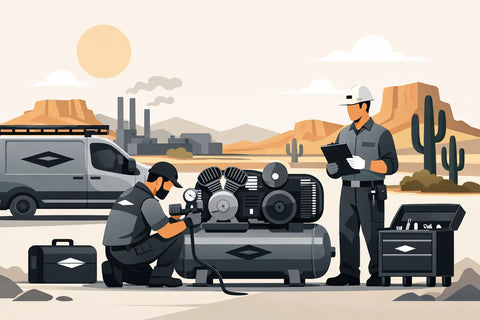
A compressor rarely fails at a convenient time. It trips during peak production, starts running hot on a Friday afternoon, or suddenly loses pressure when multiple processes need stable air at once. That is why arizona industrial air compressor repair is not just a maintenance issue - it is an uptime issue, a cost issue, and in some facilities, a safety issue.
When compressed air supports packaging lines, CNC equipment, medical systems, brewing operations, or plant utilities, every hour of poor performance shows up somewhere else. Operators work around pressure drops. Maintenance teams chase recurring alarms. Energy use climbs while output falls. Good repair work does more than get the machine running again. It identifies the cause, protects the rest of the system, and reduces the chance of the same failure coming back next month.
What Arizona industrial air compressor repair should actually solve
A true repair is not just a parts swap. In industrial environments, the compressor is only one part of a larger air system that includes dryers, filters, drains, controls, piping, receivers, and points of use. If a technician replaces a failed component without checking the conditions around it, the facility may get a short-term fix and a long-term repeat failure.
That matters in Arizona, where heat, dust, and demanding duty cycles can expose weak points quickly. High ambient temperatures can stress lubricants, coolers, motors, and electronics. Fine airborne debris can affect filters and cooling surfaces. Facilities with changing load profiles may also run compressors inefficiently, which creates extra wear and unstable air delivery.
The best repair approach starts with the symptom but does not stop there. If a unit is overheating, the issue could be low oil, a blocked cooler, poor ventilation, a fouled separator, a control fault, or an oversized demand event elsewhere in the system. If pressure is unstable, the compressor may not be the main problem at all. Restrictions, leaks, wet air, failing drains, or bad controls can produce the same complaint.
Common failures that disrupt production
Some problems are obvious. Others build gradually and only get attention once they affect output. In either case, industrial teams need repairs that move quickly and hold up under real operating conditions.
Overheating and high-temperature shutdowns
This is one of the most common and expensive service calls. Heat can come from dirty coolers, poor room ventilation, degraded lubricant, clogged filters, incorrect pressure settings, or internal wear. In Arizona facilities, ambient conditions can narrow the margin for error. A machine that runs acceptably in mild weather may become unstable during hotter periods if maintenance has slipped.
Pressure loss and poor air delivery
When production tools stop performing as expected, the compressor often gets blamed first. Sometimes that is correct. Sometimes the real issue is a leak-heavy system, saturated filters, undersized piping, or a dryer problem causing downstream restriction. Pressure complaints need system-level diagnosis, not guesswork.
Oil carryover and air quality issues
Oil in the air stream can damage product quality, affect sensitive equipment, and create compliance concerns in certain industries. The cause may be separator failure, incorrect oil, internal wear, poor maintenance practices, or operating conditions outside the machine's design range. Repairing the symptom without checking air treatment equipment often leaves the facility exposed.
Electrical and control faults
Modern compressors rely on sensors, controllers, starters, VFDs, and protection circuits. A nuisance trip may be a failing component, but it can also point to power quality issues, motor stress, cooling problems, or a control sequence error. These are not repairs to rush through. The wrong conclusion can create repeat downtime and unnecessary parts costs.
Why fast diagnosis matters more than fast guesses
In many plants, the pressure to restore production can push service calls toward the quickest visible fix. That is understandable, but it can also be expensive. Replacing the wrong valve, sensor, or motor may restart the system temporarily while the actual root cause remains in place.
The better path is a disciplined field diagnosis. That means checking operating temperature, pressure behavior, duty cycle, fluid condition, air treatment performance, control history, and the condition of wear components. It also means looking at the environment around the machine. Ventilation, installation layout, room cleanliness, and downstream demand swings all influence compressor reliability.
A dependable service partner will also tell you when repair is the right move and when it is not. If a unit has repeated major failures, poor efficiency, and rising maintenance costs, continuing to patch it may cost more than planned replacement or rental support during a transition. Not every old machine should be retired, but not every machine deserves another emergency call either.
Repair quality depends on technician experience and parts access
Industrial buyers do not need vague promises. They need technicians who understand rotary screw compressors, reciprocating units, vacuum systems, dryers, filtration, condensate management, and plant air distribution. Multi-brand knowledge matters because many facilities operate mixed equipment fleets, especially after expansions, acquisitions, or phased upgrades.
Parts access matters just as much. A strong repair partner should be able to support both authorized equipment lines and multi-brand field service. That combination reduces downtime because diagnosis is informed by real product knowledge, while service capability remains broad enough to support what is already installed.
This is where working with a full-service compressed air provider can change the outcome. When the same company can handle equipment supply, installation, parts, emergency service, and long-term maintenance, repairs tend to be more strategic. The goal shifts from getting through today to stabilizing performance over the next year.
When emergency repair is necessary and when preventive service is smarter
There are times when an emergency response is the only option. A production line is down. A backup machine cannot keep up. Air quality has fallen outside process requirements. In those moments, speed is critical.
But most major failures leave clues first. Rising discharge temperatures, increased amperage, longer load times, moisture carryover, frequent cycling, and recurring alarms usually appear before a shutdown. If those warning signs are ignored, the repair becomes larger, more expensive, and harder to schedule around operations.
Arizona industrial air compressor repair and preventive maintenance
The strongest repair strategy includes preventive maintenance because maintenance directly affects repair frequency. Filters, separators, lubricant, drains, belts, coolers, and system controls all have service intervals for a reason. Skipping them often saves very little and creates a much larger bill later.
That does not mean every facility needs the same schedule. It depends on hours, load profile, environment, redundancy, and how critical compressed air is to production. A hospital, manufacturer, municipality, and brewery may all use compressed air, but the risk tolerance and air quality requirements are different. Good maintenance planning reflects that reality instead of forcing every site into the same template.
What plant managers and maintenance teams should ask during a service call
A service visit should leave the facility with more clarity than it had before. If the only takeaway is that a part was replaced, that is not enough. Buyers should expect a clear explanation of failure cause, operating condition, and near-term risk.
Ask what caused the failure, not just what failed. Ask whether room temperature, ventilation, contamination, or downstream demand contributed. Ask whether the dryer, filters, drains, and controls were checked. Ask whether the current setup is efficient for the way the plant actually uses air. These questions often uncover preventable issues that would otherwise stay hidden until the next breakdown.
It is also worth asking whether the system has enough redundancy. Some facilities can tolerate a few hours of downtime. Others cannot. If one compressor failure stops production entirely, rental support, a second machine, or a revised system design may deserve serious consideration.
Repair is one part of system reliability
The most reliable compressed air systems are not the ones that never need service. They are the ones supported by a plan. That plan includes the right equipment, proper installation, clean air treatment, scheduled maintenance, and technicians who can diagnose the full system instead of chasing isolated symptoms.
For facilities that rely on compressed air every shift, repair should be treated as an operational discipline, not a reactive event. Advanced Air & Vacuum supports that model with certified technicians, multi-brand service capability, parts access, and maintenance programs built around uptime, not guesswork.
If your compressor is running hotter, louder, wetter, or less efficiently than it should, waiting for a shutdown usually costs more than addressing the problem now. The right repair call does not just restore air. It gives your operation a more stable place to run from tomorrow.
