
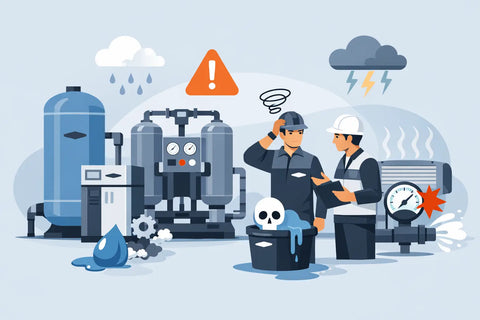
A compressor can produce plenty of air and still create a production problem. Moisture in a paint line, oil carryover in a food process, or pressure loss before a critical machine can turn an apparently healthy system into a costly source of rejects and downtime. The top compressed air treatment mistakes usually happen when treatment equipment is selected as an accessory instead of engineered as part of the complete air system.
Air treatment has one job: deliver air at the required quality, pressure, and flow rate at the point of use. That sounds straightforward, but the right solution depends on the application, operating conditions, compressor type, piping layout, and contamination risk. Avoiding the mistakes below protects product quality, equipment life, energy cost, and uptime.
Top Compressed Air Treatment Mistakes That Cost Uptime
1. Treating every application as if it needs the same air quality
Not every plant needs the same level of treatment, and over-treating can be nearly as inefficient as under-treating. A general manufacturing line may only need dry, particulate-free air. Instrument air, pharmaceutical processes, food and beverage production, electronics, painting, and breathing-air applications can demand significantly tighter controls.
The mistake is choosing a dryer and filter package based only on what was used at another facility or what is readily available. Start with the required air quality at each point of use. Consider moisture, liquid water, oil aerosol, oil vapor, particulates, microorganisms where applicable, and the consequences of a contamination event.
A point-of-use filter may make sense for a sensitive operation, while treating the entire plant to that same standard may add unnecessary capital cost and pressure drop. The best design often combines central treatment with targeted point-of-use protection.
2. Selecting a dryer without accounting for real operating conditions
Dryer ratings can be misleading when they are read without context. A dryer rated for a certain flow may not deliver that capacity when inlet air is hotter than expected, ambient temperature is elevated, system pressure is lower, or the compressor runs at full load for extended periods.
This matters in Southern California and Arizona, where high ambient temperatures can put added demand on compressed air equipment. A refrigerated dryer that performs well in a conditioned equipment room may struggle if installed beside a hot compressor in a poorly ventilated area. Likewise, a desiccant dryer selected for standard conditions can be undersized if the plant expands production or experiences a higher-than-planned peak demand.
Confirm the required pressure dew point, not just the dryer type. Refrigerated dryers are a practical choice for many general industrial applications, but they do not provide the low dew points required for applications exposed to freezing conditions or highly moisture-sensitive processes. Desiccant dryers can provide much drier air, but they require proper filtration and have different energy and maintenance considerations.
3. Installing filters in the wrong order or using the wrong element
Filters are not interchangeable. Each element is designed to address a specific contaminant load, and placement matters. A common error is installing a fine coalescing filter upstream of a dryer without adequate bulk water separation. The element can become overloaded with liquid water and oil, causing excessive pressure drop and shortening service life.
A typical treatment train begins with effective moisture separation after compression, followed by filtration that supports the dryer and downstream air-quality requirement. For oil-lubricated compressors, coalescing filtration is often necessary to capture aerosols. If oil vapor is a concern, activated carbon treatment may be needed downstream of a properly sized coalescing filter.
Do not assume an activated carbon filter removes all contaminants or can compensate for poor upstream treatment. Carbon is intended for vapor removal, not liquid oil or heavy particulate loading. When it is used incorrectly, replacement costs rise and air quality still suffers.
4. Ignoring pressure drop across treatment equipment
Every filter, dryer, separator, regulator, and section of piping creates resistance. A few pounds per square inch of pressure drop may not sound serious, but it can cause operators to increase compressor discharge pressure just to maintain acceptable pressure at the production floor. That increases energy consumption and places more stress on the system.
Pressure drop also tends to rise as filter elements load with contaminants. If differential pressure is not monitored, a filter can become a hidden restriction until a machine begins faulting or product quality changes. In some cases, teams respond by increasing pressure rather than finding the restriction. That approach masks the cause and raises operating cost.
Use properly sized treatment equipment for expected flow and peak demand. Install gauges or differential-pressure indicators where they can be checked during routine rounds. A maintenance plan should include replacement based on condition, manufacturer guidance, and operating environment, not simply the date on a calendar.
5. Forgetting that condensate needs a reliable path out
Compressed air treatment creates condensate. If that condensate is not removed consistently, water and oil can move downstream, damage dryer performance, foul filters, and contaminate air lines. Manual drains are especially vulnerable because they rely on someone being present and remembering to open them.
Automatic drains can reduce that risk, but they also need inspection. Drains can clog, stick open, leak compressed air, or fail closed. A failed closed drain allows liquid to accumulate. A failed open drain wastes energy continuously. Both conditions affect the operation.
Condensate management also has an environmental component. Compressor condensate may contain oil and should not be discharged without proper handling. An oil-water separator can help facilities manage discharge requirements, but it must be sized for the condensate volume and maintained according to its media capacity. This is not a place to improvise.
6. Placing treatment equipment where it cannot be serviced
A well-specified dryer does little good if technicians cannot access the controls, drains, filters, or service panels. Treatment equipment is often pushed into tight compressor rooms after the main equipment has been installed. That creates difficult maintenance conditions and can turn a straightforward filter change into a delayed shutdown task.
Leave clearance around dryers, filters, separators, and drain assemblies. Make sure isolation valves and bypass arrangements are designed carefully so service can be performed without interrupting air supply when the application allows it. A bypass should not become a permanent shortcut around failed treatment equipment, but it can support planned maintenance and reduce operational disruption.
Equipment location affects performance as well. Avoid placing dryers where they draw in excessive heat, dust, or corrosive vapors. Protect outdoor installations from weather while preserving ventilation. Piping should support drainage rather than creating low points that collect water and carry it toward sensitive equipment.
7. Waiting for contamination or failure before scheduling service
Air treatment problems are often gradual. A dryer may begin showing a weaker dew point. A filter may load slowly. An automatic drain may start leaking. Because compressed air is still available, these conditions can be overlooked until a critical process is affected.
Reactive service is expensive because the consequences extend beyond the failed component. Wet air can corrode piping, damage pneumatic tools and valves, ruin coatings, disrupt instrumentation, and create rejected product. The repair bill is only one part of the cost.
Preventative maintenance gives operations teams a better position. Routine inspections should verify pressure drop, dew point where required, drain operation, filter condition, separator performance, and operating temperature. Maintenance records also reveal trends that help identify undersized equipment, changing air demand, or compressor issues before they become emergencies.
Build Treatment Around the Process, Not the Compressor
The right air treatment package is not defined solely by compressor horsepower. It must be matched to air quality requirements, actual flow, peak demand, inlet conditions, pressure targets, and the risk associated with downtime or contamination. This is especially relevant when a facility adds equipment, changes production processes, or connects a new line to an older compressed air network.
A system assessment can identify whether the problem is treatment capacity, piping pressure loss, poor drainage, neglected service, or an air-quality requirement that was never clearly defined. Advanced Air & Vacuum can help facilities evaluate these factors, specify treatment equipment, complete installation, and support the system with certified technician service.
Before the next quality issue or unplanned shutdown forces a rushed decision, have your compressed air treatment system reviewed under normal operating conditions. A clear view of what is entering the system and what must reach each point of use is the practical starting point for dependable air.
