
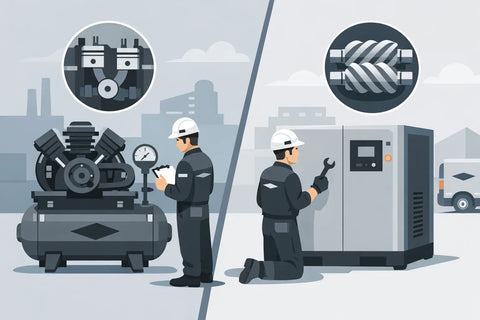
If your compressor keeps up only until production peaks, the question is not just price - it is whether you chose the right machine for the way your facility actually runs. In the reciprocating vs rotary screw compressor decision, the better option depends on demand profile, duty cycle, air quality requirements, and how much downtime your operation can tolerate.
For some facilities, a reciprocating compressor is the practical answer. For others, it becomes a bottleneck fast. A rotary screw compressor usually costs more upfront, but in the right application it can return that difference through better efficiency, quieter operation, and more dependable continuous air supply. The key is matching compressor design to real operating conditions, not just nameplate horsepower.
Reciprocating vs rotary screw compressor: the core difference
A reciprocating compressor uses pistons to compress air inside cylinders. It works in cycles, building and storing compressed air, then delivering it as needed. This design has been around for a long time because it is simple, familiar, and effective for intermittent use.
A rotary screw compressor compresses air through two meshing rotors that turn continuously. Instead of pulsing through piston strokes, it delivers a smoother, more consistent flow of air. That makes it a strong fit for facilities where compressed air is not occasional utility support, but part of daily production.
That difference in compression method affects almost everything else - noise level, maintenance intervals, pressure stability, energy use, and how well the unit handles long run times.
When a reciprocating compressor makes sense
Reciprocating compressors are often a good fit for smaller shops, lower demand applications, and operations that use air in short bursts rather than all day. If your equipment cycles on and off, your air requirement is modest, and your budget is tight, a piston machine can be a solid choice.
They also make sense where occasional use outweighs the need for continuous duty. Auto repair, light fabrication, maintenance departments, and certain service bays often do well with reciprocating units, especially when demand is predictable and storage is adequate.
The trade-off is duty cycle. Most reciprocating compressors are not built to run continuously under heavy load. Push them too hard, and heat, wear, and moisture problems tend to show up sooner. In operations where compressed air supports production every hour of every shift, that limitation matters.
When a rotary screw compressor is the better fit
Rotary screw compressors are typically the right answer for manufacturing plants, packaging lines, food and beverage operations, medical support systems, and any facility with sustained air demand. They are designed for continuous operation and generally provide more stable pressure at the point of use.
That pressure stability matters more than many buyers expect. Inconsistent air can affect valve performance, tool efficiency, automation reliability, and product quality. If your line performance changes when demand spikes, the compressor may be part of the problem.
Rotary screw systems also tend to integrate better into a complete compressed air room. Dryers, filtration, controls, storage, and monitoring can be configured as part of a broader efficiency strategy rather than treated as afterthoughts. For facilities focused on uptime, that system-level advantage is often more important than the compressor alone.
Cost is not just the purchase price
A reciprocating compressor usually wins on initial cost. If you are comparing similar horsepower ratings, the piston unit is often the less expensive machine to buy. That can make it attractive for smaller budgets or limited-use applications.
But the real cost of ownership includes energy, service, production risk, and replacement timing. A compressor that struggles to keep up, runs hot, or requires more frequent intervention can become more expensive than it looked on day one.
Rotary screw compressors generally require a higher upfront investment, especially when you include a properly designed dryer and filtration package. Still, they often deliver lower operating cost per unit of air in continuous-use environments. If your compressor runs for long periods, energy efficiency and reduced downtime can outweigh the higher purchase price.
This is where many facilities make the wrong comparison. They compare machine cost instead of system cost over time.
Duty cycle and run profile should drive the decision
If there is one factor that should lead this conversation, it is duty cycle. A reciprocating compressor is usually best for intermittent use. A rotary screw compressor is usually best for continuous use.
That sounds simple, but many plants live in the gray area. Maybe demand is low during part of the day and high during shift change. Maybe a facility started with one machine and added more air tools, packaging equipment, and automation over time. Maybe leaks and poor storage are forcing the compressor to run harder than expected.
In those cases, the right answer may not be based on compressor type alone. It may require reviewing the entire air system, including controls, receiver sizing, pressure drop, treatment equipment, and load profile. A machine that looks undersized on paper may actually be serving a poorly configured system.
Maintenance differences matter more than most buyers expect
Reciprocating compressors have more vibration and more wear points tied to piston operation. Valves, rings, gaskets, and other internal components can require closer attention, particularly in demanding service. They can be dependable machines, but they tend to ask more from maintenance teams when used heavily.
Rotary screw compressors also require planned service, but their maintenance profile is usually better suited to continuous industrial use. Fluid changes, separator replacement, filter service, and periodic inspections are all part of keeping them efficient and reliable. With a preventative maintenance program, service can be predictable rather than reactive.
For facilities where labor is stretched thin, that predictability has value. It reduces the risk of a compressor becoming one more emergency that pulls technicians away from production-critical work.
Air quality, noise, and working conditions
The reciprocating vs rotary screw compressor comparison also affects the environment around the equipment. Reciprocating compressors are usually louder and produce more pulsation. In some settings that is manageable. In others, especially where compressors are near work areas, that noise becomes a daily operational issue.
Rotary screw compressors are typically quieter and smoother. That makes them easier to place within or near production spaces when a dedicated compressor room is not practical. They also pair well with modern air treatment packages, which is important when your process depends on dry, clean air.
If your operation includes instrumentation, sensitive pneumatic controls, finishing processes, or product contact concerns, air quality should not be treated as secondary. The compressor, dryer, filters, and drain management all need to be considered together.
Which industries tend to choose each type
Smaller service shops, maintenance garages, and light-duty operations often stay with reciprocating compressors because the economics fit the workload. They do not need around-the-clock compressed air, and a simpler system may be enough.
Higher-demand environments such as manufacturing, healthcare support, municipal operations, defense-related facilities, and processing plants more often move toward rotary screw systems because uptime, consistency, and efficiency carry more weight than initial equipment cost.
That does not mean every plant needs a rotary screw compressor. It means the cost of being wrong is higher when compressed air directly affects throughput, compliance, or product quality.
How to choose the right compressor for your facility
Start with actual demand, not assumptions. Look at required CFM, pressure, daily run hours, future expansion, and how sensitive your operation is to pressure fluctuation or downtime. Then evaluate the full system, including storage, treatment, piping, controls, and service support.
If your air demand is occasional and your budget is the primary concern, a reciprocating unit may be the right fit. If your operation depends on steady air through full shifts, a rotary screw compressor is usually the safer long-term investment.
The best choice is the one that supports production without wasting energy or creating service headaches. That is why many facilities benefit from a site-specific review before buying equipment. In Southern California and Arizona, where uptime demands are high and response time matters, working with a provider that can handle equipment selection, installation, and long-term maintenance often prevents expensive mistakes after startup.
Compressed air is easy to overlook until it interrupts production. Choosing the right compressor now is usually much cheaper than fixing the wrong one later.
