
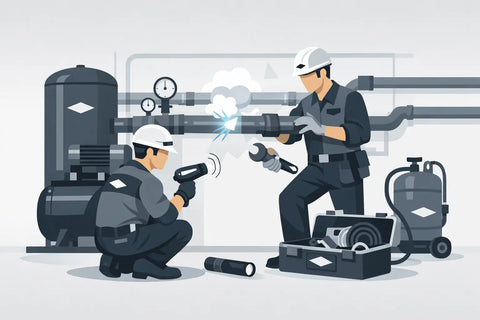
A leak that barely makes a sound can quietly run a compressor for more hours, raise electrical demand, and leave production equipment short on pressure when demand peaks. Knowing how to fix air leaks is not just a maintenance task. It is a practical way to reduce compressed air waste, stabilize system performance, and protect operating margins.
In industrial facilities, leaks commonly develop at threaded fittings, quick-connect couplings, hose connections, condensate drains, regulators, filters, valves, and worn seals. The visible leak is often only part of the problem. A system with several small leaks can force a compressor to load unnecessarily, increase cycling, and mask a larger issue such as poor piping design or inadequate pressure control.
Start With Safe, Accurate Leak Detection
Do not begin tightening fittings on a pressurized system. Follow site lockout/tagout procedures, isolate the affected section where possible, and safely depressurize the line before disassembly. Compressed air can release stored energy quickly, and a failed fitting, hose, or plug can cause serious injury.
The best time to conduct a complete leak survey is when production demand is low. With fewer machines consuming air, abnormal flow and audible leaks are easier to identify. Walk the distribution system from the compressor room outward, including headers, drops, point-of-use connections, and equipment that may operate intermittently.
Audible leaks are easy to find in a quiet area, but many industrial leaks are above normal hearing range or buried under plant noise. An ultrasonic leak detector is the most dependable tool for large facilities because it identifies the high-frequency turbulence created by escaping air. It can locate leaks without requiring the system to be shut down and gives technicians a repeatable way to document leak severity.
For accessible, low-risk connections, a soap-and-water solution can confirm a suspected leak. Bubbles indicate escaping air. This method is useful for checking a specific fitting after repair, but it is not a substitute for an ultrasonic survey across a busy plant. Avoid applying solution near energized electrical components or areas where liquid contamination is unacceptable.
How to Fix Air Leaks at Common Failure Points
A lasting repair starts with identifying the actual source. Air may appear to escape at a fitting when the real issue is a cracked hose, damaged thread, failed O-ring, or improperly supported pipe nearby. Repairing the wrong component wastes labor and usually sends the leak back into service.
Threaded Fittings and Pipe Joints
Threaded joints frequently leak because of damaged threads, incorrect sealant, contamination, or overtightening. Once the line is isolated and depressurized, remove the fitting and inspect both mating surfaces. Replace fittings with stripped, corroded, or deformed threads rather than attempting to force them tight.
Clean the threads and use a sealant rated for compressed air service. Apply it correctly so excess material does not enter the air stream, where it can contaminate valves, instruments, or downstream equipment. Reinstall the fitting to the manufacturer's torque guidance. More torque is not always better - overtightening can crack a fitting or distort threads.
Quick Couplers, Hoses, and Connectors
Quick couplers are convenient, but their internal seals wear over time. If a coupler leaks when connected or disconnected, replacing the O-ring alone may work if the body and plug are in good condition. If there is visible wear, corrosion, or inconsistent engagement, replace the coupling assembly.
Inspect hoses for abrasion, cuts, blistering, hardened sections, and loose end fittings. A hose that rubs against machinery, sharp edges, or a floor surface will fail sooner than one that is properly routed and supported. Replace damaged hoses with assemblies rated for the system pressure, temperature, and application. Do not use tape, clamps, or makeshift patches as a permanent repair on a pressurized air line.
Filters, Regulators, and Lubricators
Leaks around air preparation equipment often come from bowl seals, drain assemblies, pressure gauges, threaded ports, or improperly installed replacement elements. Check that filter bowls are not cracked and that drain valves close fully. If an automatic drain cycles continuously or leaks after cycling, it may require cleaning, adjustment, or replacement.
Regulators can also leak through their vent or relief port when internal diaphragms fail. That is an internal component problem, not a connection issue. Replace the regulator or rebuild it with the correct service kit when the manufacturer supports rebuilding.
Valves, Cylinders, and Process Equipment
A leaking solenoid valve, actuator, or pneumatic cylinder may not release air continuously. It may leak only in one position, during a cycle, or when equipment is idle. Test these components through their full operating sequence. Watch for pressure loss in isolated sections and listen near exhaust ports, valve bodies, and cylinder seals.
Repair decisions depend on the component's condition and production criticality. A serviceable valve may justify a rebuild kit. For older equipment with recurring failures, replacement is often the more reliable and economical choice. In a mission-critical process, the cost of repeat downtime can exceed the cost difference between a short-term repair and a new component.
Verify the Repair Before Returning Equipment to Service
After a repair, restore pressure gradually and test the connection again with an ultrasonic detector or soap solution where appropriate. Confirm that pressure remains stable and that the repaired equipment operates normally under load.
A useful plant-level check is to measure system behavior during a no-production period. Record compressor run time, pressure decay, and airflow before the leak campaign, then compare the same conditions afterward. This helps separate real savings from normal changes in production demand.
Do not assume every pressure issue is a leak issue. If operators are increasing compressor pressure to compensate for poor machine performance, investigate pressure drop across filters, undersized piping, restricted valves, and inappropriate point-of-use regulation. Raising system pressure to overcome a localized restriction increases energy use and can create more leakage throughout the system.
Prevent Air Leaks From Returning
Leak repair delivers the best results when it becomes part of routine compressed air maintenance rather than a one-time event. Facilities with high operating hours, multiple shifts, or high utility costs often benefit from scheduled ultrasonic surveys and a documented repair process.
Create a simple leak log that records the location, component type, severity, repair date, parts used, and verification result. Over time, this record reveals patterns. Repeated hose failures may point to poor routing. Recurring leaks at the same line may indicate vibration or insufficient support. Frequent coupler failures may mean the fitting style is not suited to the application.
Pay attention to system pressure. Every unnecessary increase in pressure makes existing leaks larger and puts more strain on components. Set pressure based on the equipment that actually needs the highest pressure, then address the reason if that requirement seems excessive. In some facilities, separate pressure zones or point-of-use boosters can serve a high-pressure application without raising pressure across the entire plant.
A preventative maintenance program should also cover compressor controls, dryers, filters, drains, piping supports, and air storage. These components affect how efficiently air reaches production equipment. A leak-free connection is valuable, but it cannot fully correct a system that is improperly sized, poorly controlled, or carrying excessive pressure drop.
When to Bring in Compressed Air Service Support
Internal maintenance teams can usually address straightforward connection leaks, hose replacement, and basic component wear. A professional assessment is valuable when leaks are widespread, pressure remains unstable after repairs, utility costs are rising, or the compressor is running more than expected during idle periods.
Certified technicians can perform a structured leak survey, identify high-cost loss points, evaluate pressure drop, and determine whether the root cause is in the compressor room, distribution piping, or point-of-use equipment. For facilities in Southern California and Arizona, Advanced Air & Vacuum can support multi-brand compressed air systems with repair, installation, and preventative maintenance service.
The most effective leak program is not the one that finds the most hissing fittings. It is the one that turns each finding into a verified repair, addresses the conditions that caused it, and keeps wasted compressed air from becoming normal operating cost.
