
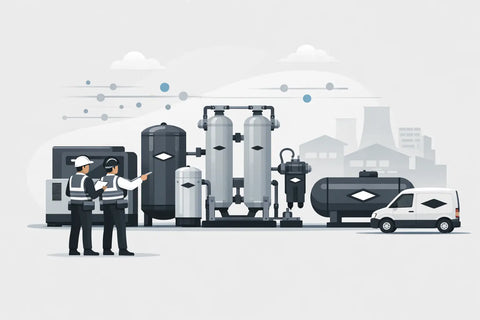
A compressor can produce the required pressure and still create an expensive production problem. Water, oil aerosols, particulate, and condensate move through the same piping as the air that powers tools, instruments, packaging equipment, and process controls. This compressed air treatment equipment guide explains how to build a treatment train that protects air quality without adding unnecessary pressure drop, energy use, or maintenance burden.
The right system is not simply a dryer and a filter. It is a coordinated approach based on the contaminant load entering the system, the air quality required at the point of use, flow demand, operating pressure, ambient conditions, and the consequences of a failure. A plant running general pneumatic tools has different requirements than a food packaging line, paint booth, medical facility, brewery, or precision manufacturing process.
Start With the Air Quality Requirement
Equipment selection should begin with the air your process needs, not the equipment catalog. ISO 8573-1 is the common framework for defining compressed air purity. It classifies air by solid particles, water content, and total oil content. Your application, equipment manufacturer, customer specifications, and regulatory obligations should determine the target class.
For example, a maintenance shop may tolerate some moisture downstream of a compressor if tools are lubricated and the system is drained correctly. A laser cutting system, instrument air network, powder coating line, or product-contact application may require a much lower pressure dew point and substantially lower oil carryover. Specifying filtration beyond the real requirement can increase pressure drop and replacement costs. Specifying too little treatment can create scrap, corrosion, failed controls, and unplanned downtime.
Document each critical use point before sizing equipment. Identify required pressure, peak and average airflow, desired dew point, oil sensitivity, particle sensitivity, and whether demand is continuous or intermittent. This prevents the common mistake of applying one air-quality standard across an entire facility when only certain production areas require premium air.
The Core Compressed Air Treatment Equipment
A typical treatment system removes contaminants in stages. The order matters because each component protects the next one and improves overall performance.
Water Separators Remove Bulk Liquid
After compression, hot air cools and releases condensate. A properly sized water separator installed after an aftercooler removes bulk liquid water before it enters the receiver, dryer, and filters. It does not dry the air by itself, but it reduces the load on downstream equipment.
Separators should be selected for actual flow at operating conditions, not just the compressor nameplate. Undersizing can allow water to bypass the separator during peak production. Pair the separator with a reliable automatic drain. A separator that collects water but cannot discharge it is not protecting the system.
Dryers Control Moisture at the Dew Point
Dryers are selected by the required pressure dew point. Refrigerated dryers are often the practical choice for general manufacturing applications where a pressure dew point around 35 to 39 degrees Fahrenheit is acceptable. They are cost-effective, straightforward to operate, and well suited to indoor systems that are not exposed to freezing conditions.
Desiccant dryers are used when very dry air is required, commonly delivering pressure dew points of minus 40 degrees Fahrenheit or lower. Heatless, heated, blower purge, and heat-of-compression designs each have different energy and maintenance profiles. A heatless dryer may be reliable and compact, but it consumes purge air. A heated or blower purge design can reduce purge loss, although it adds equipment complexity and electrical demand.
Dryer capacity changes with inlet temperature, pressure, ambient conditions, and airflow. Selecting from a standard rating at ideal conditions can result in wet air during summer heat, high-demand shifts, or low-pressure operation. In Southern California and Arizona, high ambient temperatures can materially increase the moisture load, especially where compressor rooms are poorly ventilated.
Filters Address Particles and Oil
Filters remove contaminants that a separator or dryer cannot fully handle. Their placement and grade should follow the air-quality target. A general arrangement may include a particulate prefilter before the dryer, a coalescing filter for oil aerosols, and a final particulate filter downstream where high-purity air is required.
Coalescing filters are effective for oil aerosol and fine particulate removal, but they create pressure drop as elements load. Differential pressure indicators help maintenance teams replace elements based on condition instead of guesswork. Carbon filters can reduce oil vapor and odor, but they should not be used as a substitute for coalescing filtration. Liquid oil can quickly exhaust a carbon element.
Do not assume an oil-free compressor eliminates the need for filtration. Ambient intake air carries particles, water vapor, and hydrocarbons. Piping can introduce scale and debris. The required air quality at the use point still determines the treatment strategy.
Drains Handle Condensate Without Wasting Air
Every separator, receiver, dryer, and filter housing that collects condensate needs an effective drain. Timed drains are simple, but they can waste compressed air when they open without condensate present or fail closed when debris interferes with operation. Demand-operated, zero-loss drains discharge only when needed and are often a better fit for systems where energy costs and reliability matter.
Drain discharge must also be managed correctly. Compressor condensate can contain lubricants and other contaminants. An oil-water separator can help facilities meet disposal requirements by separating compressor oil from collected water before discharge. Local rules and site procedures should always determine the final disposal method.
Size for Real Operating Conditions
Treatment equipment must handle more than the compressor's rated output. Consider multiple compressors running together, future production growth, intermittent high-flow equipment, and the effect of compressed air storage. A dryer that is adequate at average demand may be overwhelmed during a shift change, blast cycle, or process startup.
Pressure drop deserves equal attention. Every filter, dryer, regulator, hose, and undersized fitting consumes pressure. When pressure at the production line falls, operators often raise the compressor setpoint. That response increases energy consumption and may mask the real issue. Maintaining clean filter elements, properly sized piping, and appropriate equipment capacity is usually a less expensive solution than running the entire system at higher pressure.
Where air quality requirements vary, a central treatment system combined with point-of-use polishing often provides the best balance. General plant air can receive bulk moisture and particulate removal, while a paint booth, instrument line, or sensitive packaging machine receives dedicated final filtration or drying. This approach avoids treating every cubic foot of air to the highest purity class.
Installation Details That Affect Performance
Even well-selected treatment equipment can underperform when installation is rushed. Install aftercoolers and separators where they can remove moisture before it travels into the distribution system. Use correctly sized piping, provide drain legs at low points, and keep takeoffs at the top of the main header to limit water carryover.
Filters and dryers need service clearance. Technicians should be able to inspect gauges, replace elements, access drains, and service valves without shutting down unrelated production areas. A bypass arrangement can support maintenance in critical systems, but it must be controlled carefully. Bypassing treatment equipment during production may expose sensitive processes to contamination.
Monitoring adds practical value. Dew point monitoring is especially useful for desiccant dryer applications, while differential pressure monitoring identifies loaded filters. Flow and pressure data can reveal demand changes, air leaks, or capacity limitations before they become an emergency call.
Build Maintenance Into the Plan
Compressed air treatment is not install-and-forget equipment. Drain strainers clog, filter elements load, desiccant ages, refrigerant dryers need inspection, and controllers require verification. Deferred maintenance often appears first as wet air, pressure loss, rising energy use, or inconsistent product quality.
A proactive maintenance plan should track service intervals while responding to actual operating conditions. Record filter differential pressure, dryer dew point, drain operation, and compressor oil carryover trends. These readings give maintenance teams useful evidence when deciding whether a problem is isolated to a component or points to a larger system issue.
For facilities with limited in-house capacity, certified technicians can inspect the full treatment train, evaluate multi-brand equipment, replace consumables, and identify issues before a production line is affected. Advanced Air & Vacuum can support system design, installation, service, and preventative maintenance for organizations that need one accountable resource from compressor discharge to point of use.
The best treatment system is the one that delivers the air quality your process actually requires, at the lowest practical lifecycle cost. Start with a clear air-quality specification, verify real operating conditions, and keep the equipment maintained. That is how compressed air stays a dependable utility instead of becoming the source of the next shutdown.
