
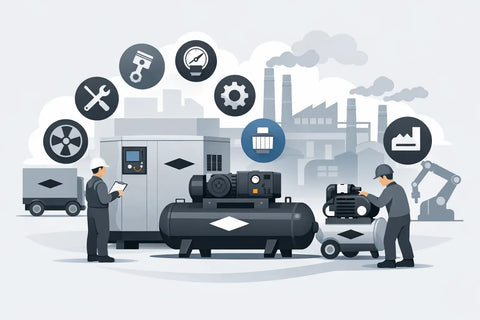
When a compressor goes down, the brand name on the package stops being a marketing detail and starts being an operations decision. That is why buyers looking for the best industrial air compressor brands are usually not asking who has the flashiest brochure. They want to know which manufacturers hold up under load, which ones are serviceable in the field, and which ones make sense for the way their facility actually runs.
For most plants, there is no single "best" brand in every situation. The right choice depends on duty cycle, air quality requirements, utility costs, redundancy plans, maintenance staffing, and how quickly you can get parts and service when something fails. A good compressor brand matters. A good support strategy matters just as much.
What separates the best industrial air compressor brands
In industrial settings, compressor selection is not just about rated horsepower. The brands that perform well over time tend to stand out in a few practical areas.
First is reliability under real operating conditions. A compressor may look good on paper, but high ambient temperatures, dirty environments, variable demand, and continuous production schedules expose weak points quickly. The strongest brands have a track record in plants, not just in specs.
Second is serviceability. Even well-built systems need filters, oil, separators, controllers, and occasional repairs. If your maintenance team or service partner can work on the machine efficiently, downtime is shorter and total cost stays under control. If every issue becomes a long wait for parts or specialized support, the initial purchase price stops looking attractive.
Third is system efficiency. Energy is often the largest lifetime cost in a compressed air system. Brands that offer efficient airends, strong controls, variable speed options, and good integration with dryers and filtration can reduce operating cost in a meaningful way.
Fourth is application fit. A hospital, a machine shop, a food plant, and a defense contractor may all use compressed air, but not in the same way. The best brand for one facility may be the wrong one for another.
8 best industrial air compressor brands to consider
Atlas Copco
Atlas Copco is often on the short list when uptime, controls, and long-term efficiency matter. The brand is well known for rotary screw compressors, variable speed technology, and broad system integration across dryers, filtration, controls, and monitoring.
Where Atlas Copco usually stands out is in larger or more demanding operations where energy performance and system design have a direct impact on cost. The trade-off is that premium equipment generally comes with a premium price. For facilities that run hard every day, that higher upfront cost can still make financial sense.
Quincy
Quincy has a strong reputation in industrial compressed air, especially for buyers who want dependable equipment with a long service history in American manufacturing environments. The lineup covers both rotary screw and reciprocating options, making it relevant for a wide range of plant needs.
Quincy is often a good fit for operations that want proven performance without overcomplicating the purchase. As with any brand, model selection matters. A well-matched Quincy package can serve a plant for years, but the wrong sizing strategy will create the same problems you would see with any manufacturer.
Hertz
Hertz is a practical option for industrial users who need solid performance and value, particularly in rotary screw applications. The brand appeals to buyers who want dependable compressed air equipment without paying for features they may never use.
This can be a strong choice for mid-size industrial facilities, general manufacturing, and plants looking to balance budget with reliability. The key question is support. A value-driven machine backed by a knowledgeable distributor and service team is far more attractive than a cheaper unit that becomes difficult to maintain.
Schulz
Schulz has built recognition across multiple compressor categories and is often considered by buyers looking for cost-effective industrial solutions. In the right application, it can be a smart fit for operations that need reliable compressed air without stepping into the highest capital cost tier.
That said, buyers should evaluate the specific duty cycle carefully. If the plant has nonstop production demands, high air quality requirements, or limited tolerance for interruption, support access and maintenance planning should weigh heavily in the decision.
Ingersoll Rand
Ingersoll Rand remains one of the most recognized names in industrial air. The brand has deep market penetration, a broad installed base, and equipment options that fit many commercial and industrial environments.
One advantage of a widely used brand is familiarity. Maintenance teams and service providers often know the equipment well, which can simplify service. The downside is that the brand name alone should not drive the decision. Some buyers pay for familiarity when a different platform may better match their operating profile.
Kaeser
Kaeser is respected for engineering quality, efficiency, and system-focused design. The brand is particularly strong in facilities where compressed air is treated as a utility rather than a standalone machine purchase.
Kaeser equipment often appeals to plants focused on lifecycle cost, stable performance, and integrated controls. It may be less attractive to buyers shopping purely on initial price, but for energy-conscious operations, that is often the wrong metric anyway.
Sullair
Sullair is known for durable compressor packages and a reputation for performing in demanding industrial conditions. It is a brand many buyers associate with heavy-duty use and long equipment life.
For facilities with rugged environments or continuous operation, Sullair deserves consideration. As always, it comes down to how the package is configured and supported. Even a durable machine will struggle if the air treatment is undersized or the maintenance plan is inconsistent.
Gardner Denver
Gardner Denver has longstanding credibility in compressed air and a broad footprint across industrial applications. Buyers often look at the brand when they want established equipment with options across different performance levels and plant requirements.
It can be a solid fit for facilities that want an experienced manufacturer with a wide range of configurations. The practical question is whether the local support network is strong enough to back the machine after startup.
How to compare industrial compressor brands the right way
If you are evaluating the best industrial air compressor brands, start with the system, not the logo. A compressor should be selected based on your actual load profile, pressure requirements, air quality standards, and future growth. Too many facilities buy based on nominal capacity and end up paying for pressure drop, excess run time, and unstable performance later.
Look closely at energy use. Variable speed compressors can be excellent in variable-demand environments, but they are not automatically the right answer for every plant. In a stable base-load application, a fixed-speed compressor may be the better value. This is where brand comparisons need context.
Also consider maintainability. Ask how often routine service is required, how easy consumables are to replace, and how quickly major parts can be sourced. If your operation cannot tolerate downtime, a maintenance plan and emergency response capability should carry real weight in the buying process.
Air treatment matters too. Dryers, filters, separators, drains, and piping design all affect performance. A strong compressor brand paired with poor downstream equipment is still a poor compressed air system. Buyers who focus only on the compressor package often miss where the avoidable waste is actually happening.
Why service support matters as much as the brand
A high-quality compressor can still become a problem asset if support is weak. That is especially true in plants where compressed air drives production equipment, instrumentation, packaging, automation, or critical process functions.
The better approach is to evaluate brand and service together. Can the supplier size the system correctly, install it properly, commission it under load, and support it with certified technicians? Can they handle rentals, emergency repairs, preventative maintenance, and multi-brand service if your compressor room includes older equipment? Those answers affect uptime more than a product brochure does.
For many industrial buyers, the best decision is not simply choosing a top manufacturer. It is choosing a brand that is backed by local inventory, technical support, and a service team that understands your plant. That is where long-term value shows up.
Which brand is best for your facility?
If your priority is top-tier efficiency and advanced controls, Atlas Copco and Kaeser are often strong candidates. If you want proven industrial dependability with broad market familiarity, Quincy, Ingersoll Rand, Sullair, and Gardner Denver are common considerations. If value and practical performance are central to the decision, Hertz and Schulz may make good sense in the right environment.
There is no shortcut around proper evaluation. The best brand for a high-demand manufacturing plant may not be the best brand for a municipal facility, healthcare application, or expanding production line. That is why experienced buyers look beyond horsepower and price. They evaluate lifecycle cost, air quality, service access, and how the equipment fits the operation as a whole.
If you are weighing options, bring your demand profile, maintenance history, and future capacity plans into the conversation early. The right compressor brand should do more than produce air. It should make your system easier to run, easier to maintain, and less likely to become the reason production stops.
